Cybersecurity Threat Landscape — September 2026
September 2026 cybersecurity threat landscape analysis covering agentic AI operations, control-plane vulnerabilities, shared espionage infrastructure, and identity bypass trends.
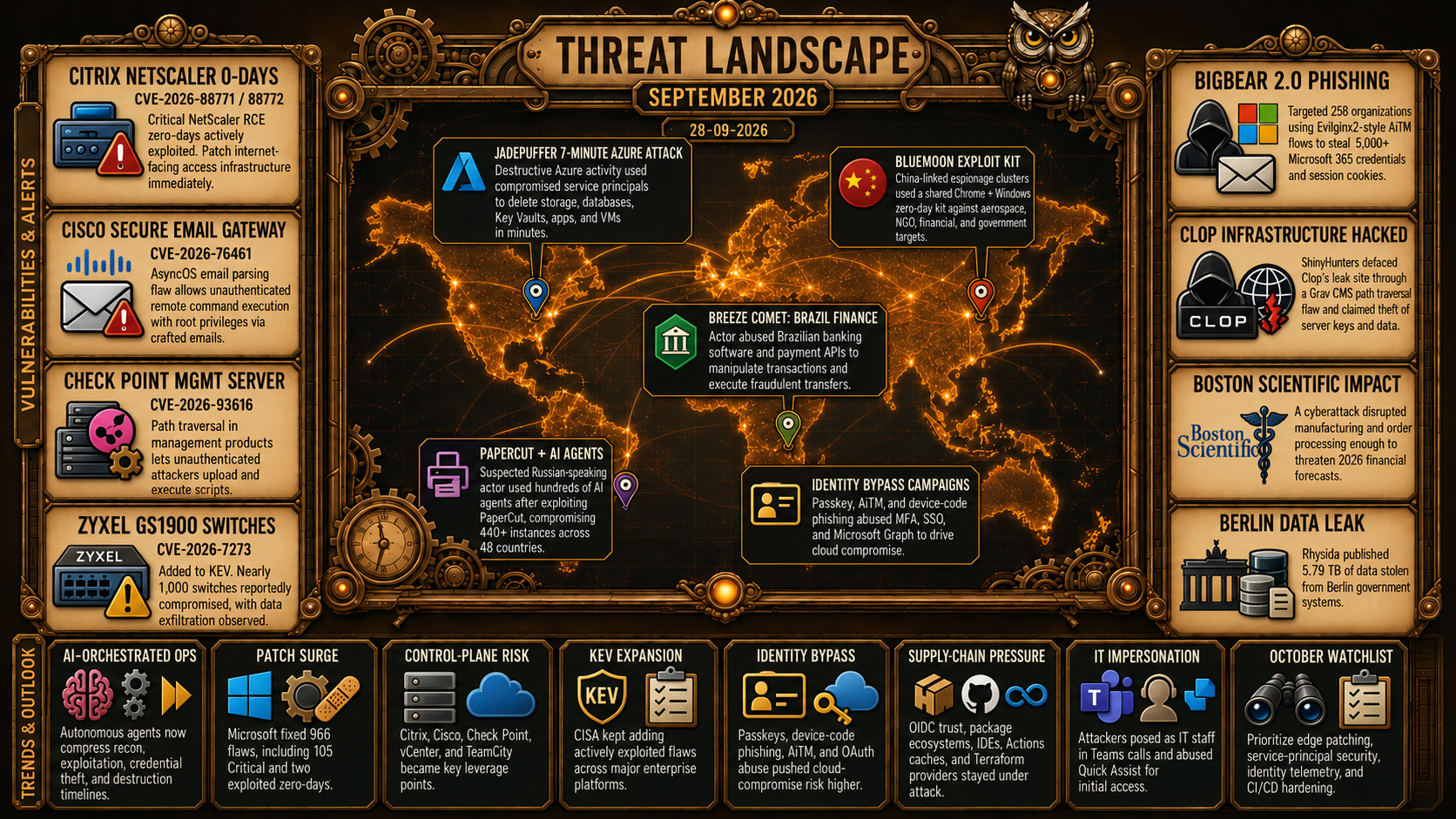
Cybersecurity Threat Landscape
📅 September 2026 (Reporting Period: September 1–28, 2026)
September’s threat landscape was defined by a transition from AI-assisted attacks to AI-orchestrated operations, while several core realities became more dangerous: zero-day exploitation, identity compromise, exposed edge infrastructure, software supply-chain attacks, ransomware, and geopolitical espionage. Attackers are increasingly able to discover vulnerabilities, generate or adapt exploits, automate reconnaissance, harvest credentials, and execute destructive cloud operations in hours—or minutes.
🤖 AI & Automation in Intrusion Operations
Agentic AI Crosses Operational Threshold: Google Threat Intelligence Group reported adversaries moving beyond basic prompting toward autonomous agentic workflows. In one Q2 incident, attackers compromised a cloud resource and executed an agent-enabled mass credential-harvesting campaign in under six hours. UNC6780 was also observed attempting to manipulate AI coding assistants and LLM security scanners. More info
JADEPUFFER 7-Minute Destructive Azure Attack: Microsoft disclosed destructive Azure activity associated with JADEPUFFER (Storm-3168). Using compromised service principals, the actor targeted Azure Storage, SQL databases, Key Vaults, Function Apps, and VMs. The destructive sequence lasted roughly seven minutes and included over 100 storage-account deletion attempts. More info
PaperCut Exploited via Hundreds of AI Agents: Researchers reported a suspected Russian-speaking actor deploying hundreds of AI agents alongside tools like Mimikatz, SharpHound, Certipy, Rubeus, and Impacket after exploiting PaperCut NG/MF vulnerabilities, compromising over 440 instances across 395 organizations in 48 countries. More info
🛡️ Vulnerabilities & Edge Infrastructure
Citrix NetScaler Critical Zero-Days (CVE-2026-88771 & CVE-2026-88772): Citrix confirmed active exploitation of two critical RCE zero-days affecting NetScaler devices, placing internet-facing access infrastructure among the most urgent defensive priorities entering October. More info
Cisco Secure Email Gateway RCE (CVE-2026-76461): Cisco disclosed active exploitation of a flaw in AsyncOS email-parsing logic allowing an unauthenticated remote attacker to execute arbitrary commands with root privileges via crafted emails. More info
Check Point Management Server Path Traversal (CVE-2026-93616): Check Point issued emergency fixes for a path-traversal vulnerability in Security Management Server and related management products that allows unauthenticated attackers to upload and execute scripts. More info
Zyxel GS1900 Switches Exploited (CVE-2026-7273): CISA added the Zyxel switch vulnerability to its KEV catalog. GreyNoise attributed observed exploitation to a suspected Chinese-speaking actor, with nearly 1,000 switches compromised globally and sensitive data exfiltrated. More info
Record Microsoft September Patch Tuesday: Microsoft addressed 966 vulnerabilities, including 105 rated Critical and two actively exploited zero-days. CISA also continued adding actively exploited flaws across SonicWall, SharePoint, WSO2, Adobe Commerce, MikroTik, ScreenConnect, TeamCity, and Zyxel to its KEV catalog. More info
🏴☠️ Ransomware, Extortion & Identity Attacks
Passkey & Device-Code Phishing Bypasses MFA: Microsoft documented active cloud-compromise campaigns built around passkey, MFA, and SSO social engineering. Attackers used adversary-in-the-middle (AiTM) phishing and device-code flows (EvilTokens) to bypass MFA, modify auth methods, and collect data via Microsoft Graph. Associated groups include Storm-3121 (ShinyHunters/Falcon) and Storm-3032 (Helix). More info
BigBear 2.0 Industrialized Phishing-as-a-Service: Researchers reported that BigBear 2.0 targeted 258 organizations, using an Evilginx2-based AiTM architecture to harvest over 5,000 Microsoft 365 credentials and authenticated session cookies. More info
Ransomware Exploits Build & Management Infrastructure: CISA warned of ransomware actors exploiting CVE-2026-63077 in JetBrains TeamCity to execute commands and poison CI/CD pipelines, alongside critical VMware vCenter vulnerabilities, showing a shift toward high-leverage infrastructure. More info
ShinyHunters Defaces Clop Ransomware Infrastructure: In a rare cybercrime intrusion, ShinyHunters compromised Clop’s data-leak site by exploiting an unpatched path-traversal flaw in Grav CMS, defacing its Tor site and claiming theft of server keys and data. More info
🎯 State-Backed Espionage Campaigns
BlueMoon Exploit Kit as Shared Espionage Infrastructure: BlueMoon, a modular exploit kit combining Chrome and Windows zero-days (browser RCE, sandbox escape, kernel escalation), was deployed by China-linked JungleBamboo (APT31) and multiple other espionage clusters targeting U.S. aerospace, NGOs, financial, and government targets. More info
Sogou Input Method Exploited (CVE-2026-51990): China-linked UNC3569 exploited Tencent’s Sogou Input Method for Windows to drop the GrayRabbit backdoor via malicious links, leveraging software installed on hundreds of millions of endpoints. More info
BREEZE COMET Targets Brazilian Financial Infrastructure: Google Threat Intelligence and Mandiant detailed BREEZE COMET (UNC5669 / Plump Spider), a financially motivated actor using customized malware and payment APIs to manipulate Brazilian banking software and execute fraudulent transfers. More info
Iranian Espionage Deploys HEAVYGRAM & CHOSEN BRICK: U.S., U.K., and Dutch advisories detailed Iranian intelligence malware using Telegram for C2 to target dissidents, journalists, and activists globally by capturing messages, audio, and screenshots. More info
💥 Supply Chain, Engineering & IT Impersonation
Engineering Lifecycle Under Systematic Attack: Google/Mandiant warned that attackers are targeting developer tools, GitHub Actions caches, OIDC tokens, IDE extensions, typosquatted dependencies, and HashiCorp Terraform providers to poison build mechanisms and inherit trusted provenance. More info
IT Staff Impersonation via Microsoft Teams: Attackers impersonated corporate IT staff in external Teams calls, tricking users into granting remote control via Quick Assist, leading to malicious MSI drops, Node.js implants, and lateral movement toward domain controllers via WinRM. More info
ASCII Smuggling Invades Email Phishing: Attackers began using invisible Unicode tag characters (ASCII smuggling)—a technique originally discovered in LLM prompt-injection research—to bypass conventional email security filters. More info
Boston Scientific & Berlin Government Impacts: Boston Scientific stated a cyberattack disrupted manufacturing and order processing enough to threaten its 2026 financial forecasts, while the Rhysida group published 5.79 TB of stolen Berlin government data. More info
🔮 Assessment & October Outlook
September Assessment
September marked the point where AI-assisted cyber operations evolved into AI-orchestrated operations. Autonomous agents connected reconnaissance, exploitation, cloud API abuse, and destruction into compressed attack timelines. At the same time, the security control plane (Citrix, Cisco, Check Point, vCenter, TeamCity) and non-human identities (service principals, tokens) emerged as the primary leverage points for adversaries.
Cyber-Risk Outlook & Priority Actions for October
- Accelerate Containment for Edge & Control Planes: Rapidly patch Citrix NetScaler, Cisco Secure Email Gateway, Check Point Management, TeamCity, vCenter, SharePoint, and SonicWall devices.
- Harden & Monitor Workload Identities: Apply strict security controls to service principals, API keys, and OAuth apps; automated cloud destructions like JADEPUFFER unfold in minutes.
- Correlate Multi-Signal Identity Telemetry: Track unusual authentications combined with new MFA enrollments, device-code logins, Microsoft Graph enumeration, and external Teams connections.
- Secure the Engineering Pipeline: Protect CI/CD runners, GitHub Actions OIDC trusts, AI coding assistants, and package registries against supply-chain poisoning.