Cybersecurity Newsfeed - 25/09/26
Daily cybersecurity news covering vulnerabilities, adversaries, trends, breaches, and other notable security developments.
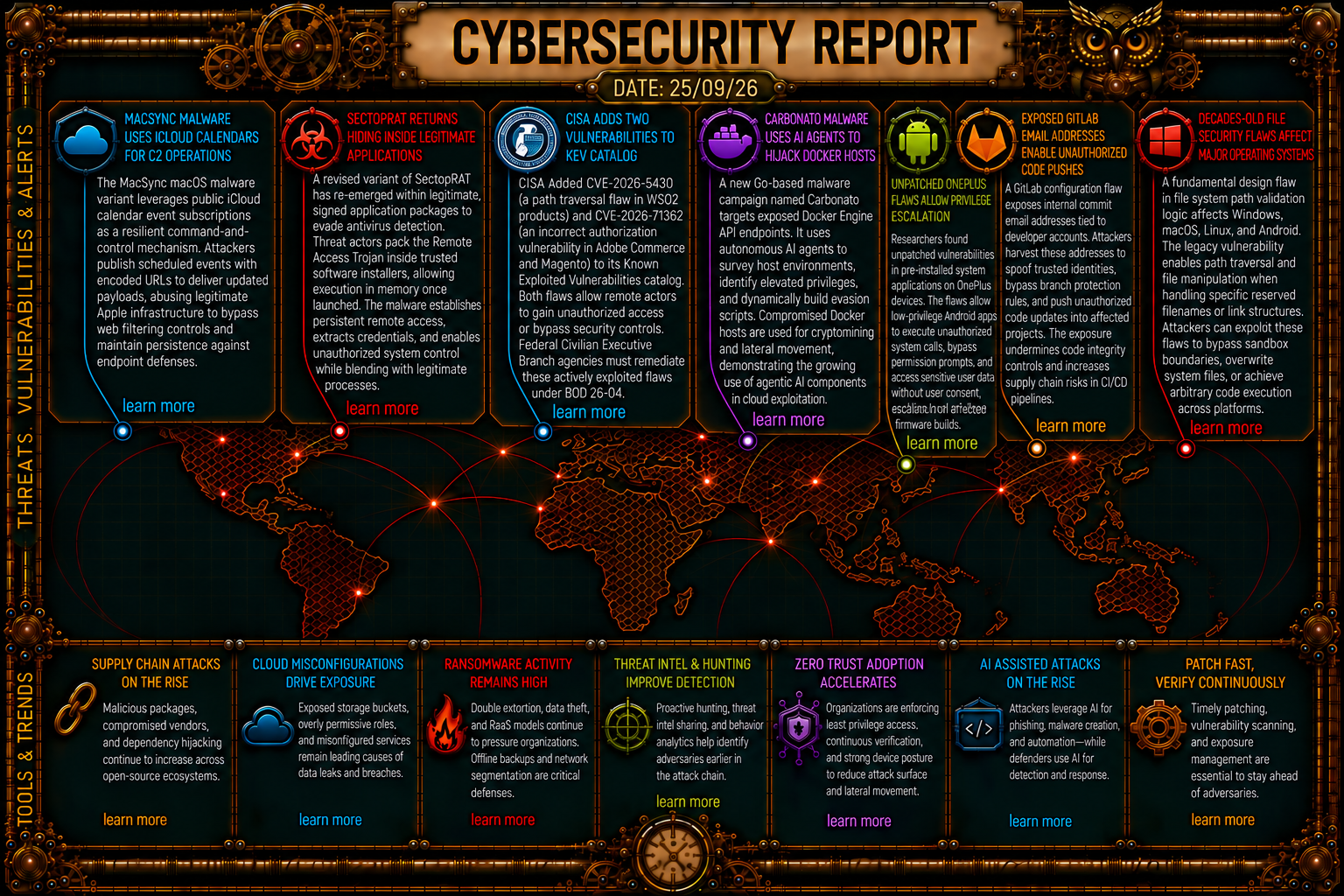
Cybersecurity Newsfeed
📅 25/09/26
🛡️ Vulnerabilities
CISA Adds Two Known Exploited Vulnerabilities to Catalog: CISA added CVE-2026-5430 (path traversal in WSO2 products) and CVE-2026-71362 (incorrect authorization in Adobe Commerce/Magento) to its KEV catalog. Federal agencies must remediate these actively exploited flaws per BOD 26-04. More info
Unpatched OnePlus Flaws Let Installed Apps Escalate Privileges: Security researchers discovered unpatched vulnerabilities in pre-installed OnePlus system applications, allowing low-privilege Android apps to execute unauthorized system calls and escalate privileges. More info
Exposed GitLab Project Email Addresses Let Attackers Push Code: A flaw in GitLab repository settings exposes internal commit email addresses, allowing threat actors to spoof trusted committers, bypass branch protection, and push unauthorized code. More info
Decades-Old File Security Flaws Found in Android, Linux, macOS, and Windows: A fundamental path validation design flaw affecting major operating systems allows path traversal, sandbox bypasses, and arbitrary code execution when handling specific reserved filenames. More info
Critical Roundcube Flaw Now Actively Exploited in Code Injection Attacks: A critical code injection flaw in Roundcube webmail is being actively exploited via crafted emails containing JavaScript, allowing full control over target email sessions. More info
Prompt-Injection Bug Hits Agentic AI App Manus: An indirect prompt-injection vulnerability in autonomous AI app Manus enables attackers to bypass security filters via JSFuck obfuscation and execute code to exfiltrate connected service tokens. More info
CISA Warns Ransomware Gangs Are Exploiting Critical TeamCity Flaw: Ransomware actors are actively exploiting a critical authentication bypass in JetBrains TeamCity servers to create admin accounts and deploy ransomware payloads. More info
Ubuntu Releases Patch Schedule for Ubuntu Kernel CVE Vulnerabilities: Canonical published a maintenance release schedule addressing privilege escalation, DoS, and memory corruption kernel vulnerabilities across supported Ubuntu versions. More info
🎯 Adversaries
MacSync Malware Uses Public iCloud Calendars to Deliver New Payloads: MacSync leverages public iCloud calendar event subscriptions as a resilient C2 mechanism to deliver secondary payloads and bypass standard web filtering. More info
SectopRAT Returns, Hiding Inside Legitimate Application: A revised variant of SectopRAT is being packed inside trusted software installers to execute in memory, establish remote access, and steal host credentials. More info
New Carbonato Malware Uses AI Agents to Hijack Exposed Docker Hosts: The Carbonato campaign targets publicly accessible Docker Engine APIs, using embedded AI agents to survey environments, construct evasion scripts, and deploy cryptominers. More info
Hacked Ukrainian Sites Serve Fake Software Updates Carrying Malware: Compromised Ukrainian websites are delivering drive-by downloads via fake update notifications to distribute RATs and infostealers in watering-hole attacks. More info
Corporate MDM Spyware Targets Logistics Sector Operations: A targeted campaign tricks logistics workers into installing rogue Mobile Device Management (MDM) profiles, enabling attackers to intercept communications and track endpoints. More info
RemControl Android Banking Trojan Disguised as Fake TV App: The RemControl trojan spreads through fake streaming apps, abusing Android Accessibility Services to log keystrokes, intercept MFA tokens, and steal banking credentials. More info
Malicious npm Packages Evade Defensive Analysis Controls: Threat actors are publishing obfuscated npm packages with dynamic payload execution that detect sandbox environments before stealing developer credentials and API keys. More info
Updated MacSync Variant Enhances Evasion Capabilities: An updated variant of MacSync features anti-analysis capabilities, inspecting sandbox parameters and terminating security processes prior to exfiltrating browser and wallet data. More info
TeamFiltration Framework Compromises Corporate Environments: Attackers are using the TeamFiltration framework to automate password spraying and data exfiltration against M365 environments, leading to tenant compromises. More info
Placeholder Domain in Developer Docs Repurposed for ClickFix Attacks: Attackers registered an expired domain referenced in developer documentation to host ClickFix social engineering attacks that trick users into pasting malicious scripts into terminals. More info
📈 Trends
OAuth Phishing Attacks Bypass Passwords and Multi-Factor Authentication: Attackers are deploying OAuth consent phishing campaigns to trick users into authorizing rogue third-party apps, securing persistent API access without triggering MFA. More info
Google Assures Critical Infrastructure Organizations Over AI Security Scanners: Google outlined encryption boundaries and safeguards for its automated AI safety scanners to reassure critical infrastructure operators regarding proprietary data privacy. More info
New Browser Guard Features Add Protection Before and After You Click: Malwarebytes updated Browser Guard with pre- and post-click detection mechanisms, behavioral monitoring, and script-blocking to stop web threats. More info
Secrets Sprawl Highlights Growing Enterprise Identity Challenges: Unmanaged API keys and hardcoded credentials in repositories continue to expose organizations to lateral movement, highlighting the need for automated detection and short-lived tokens. More info
📚 Others
- Microsoft Resolves Windows Backup Issues Caused by September Updates: Microsoft issued an out-of-band update resolving a Windows Backup feature bug introduced during the September update cycle. More info