Cybersecurity Threat Landscape — June 2026
June 2026 threat landscape analysis covering control-plane warfare, edge-device compromises, AI supply chain risks, and state-backed espionage trends.
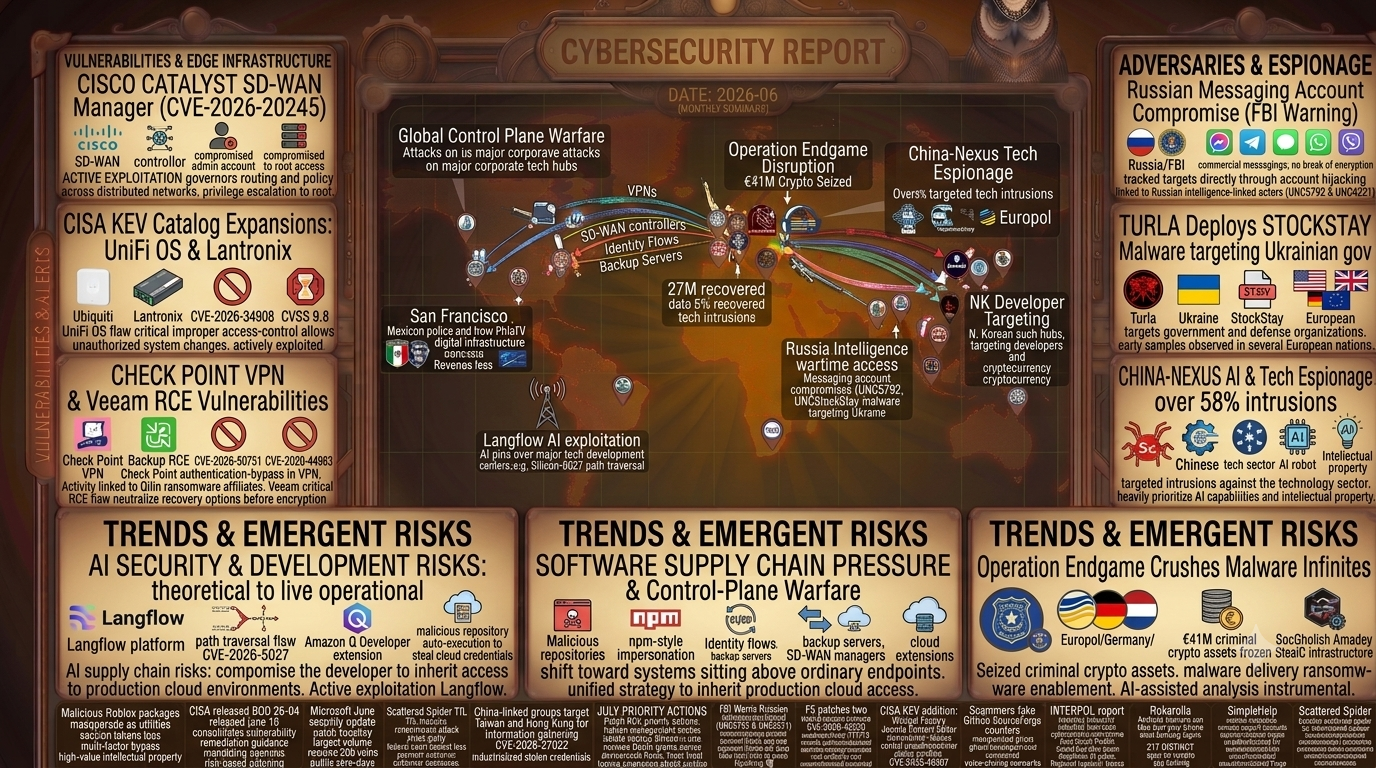
Cybersecurity Threat Landscape
📅 June 2026
June’s story is simple: attackers are no longer just breaking into companies; they are fighting for control of the infrastructure that companies use to connect, recover, build software, and authenticate users. The month’s center of gravity sat around VPNs, SD-WAN controllers, firewalls, backup platforms, AI developer tools, cloud credentials, infostealers, and state-backed espionage.
🛡️ Vulnerabilities & Edge Infrastructure
Cisco Catalyst SD-WAN Manager (CVE-2026-20245): Google/Mandiant reported active exploitation of this flaw, where a threat actor escalated from a compromised administrative account to root-level access against SD-WAN infrastructure at a service provider. This is highly critical as it governs routing and policy across distributed networks. More info
CISA KEV Catalog Expansions: CISA added exploited vulnerabilities affecting Ubiquiti UniFi OS and Lantronix EDS5000 to its Known Exploited Vulnerabilities catalog. The UniFi OS flaw (CVE-2026-34908) is a critical improper access-control issue allowing unauthorized system changes. More info
Check Point Remote Access VPN (CVE-2026-50751): Active exploitation was confirmed for this authentication-bypass vulnerability in Remote Access VPN, Mobile Access, and Spark Firewall deployments using deprecated IKEv1. Activity is linked with medium confidence to Qilin ransomware affiliates. More info
Veeam Backup & Replication (CVE-2026-44963): Veeam patched a critical flaw allowing remote code execution on backup servers by authenticated domain users. Ransomware crews heavily target these systems to neutralize recovery options before encryption. More info
Credential exposure stayed central FortiBleed became one of June’s clearest examples of how stolen credentials can turn perimeter infrastructure into an initial-access market. BleepingComputer reported that the exposed dataset contained credentials tied to 73,932 Fortinet firewall URLs worldwide, including usernames, email addresses, and plaintext passwords. The operational risk is immediate: rotate credentials, enforce MFA, restrict management access, terminate suspicious sessions, and review VPN/firewall logs. learn more
Massive June Patch Tuesday: Microsoft’s June security update was marked as the largest Patch Tuesday volume since the program began, resolving 206 vulnerabilities, including three publicly disclosed zero-days. More info learn more
🎯 Adversaries & Espionage
Russian Messaging Account Compromise: The FBI warned that Russian intelligence-linked actors (UNC5792 and UNC4221) compromised individual commercial messaging accounts. They tracked targets directly through account hijacking without breaking the underlying encryption of the apps. More info
Turla Deploys StockStay Malware: Google researchers identified “StockStay,” a Turla-linked malware family primarily targeting Ukrainian government and defense organizations, with early samples also observed in several European nations. More info
China-Nexus AI & Tech Espionage: According to a CrowdStrike report, China-linked adversaries accounted for over 58% of state-sponsored targeted intrusions against the technology sector, heavily prioritizing AI capabilities and intellectual property. More info
North Korean Target Alignments: North Korean threat operations remained strongly aligned with developer targeting, macOS malware, crypto-currency theft, and credential-harvesting campaigns. More infolearn more
📈 Trends & Emergent Risks
AI Security & Development Risks: AI shifted from theoretical risk to live operational exposure. CVE-2026-5027 (a path traversal flaw in the Langflow AI building platform) saw active exploitation leading to remote code execution. Separately, an Amazon Q Developer VS Code extension flaw allowed malicious repositories to abuse MCP auto-execution to steal cloud credentials. More info
Software Supply Chain Pressure: Attacks focusing on Amazon Q, malicious repositories, AI coding assistants, npm-style impersonation, and CI/CD secrets point to a unified strategy: compromise the developer to inherit access to production cloud environments. More info
💥 Law Enforcement & Disruptions
- Operation Endgame Crushes Malware Infinites: Europol announced a major coordinated cybercrime disruption targeting SocGholish, Amadey, and StealC infrastructure. The operations seized over €41 million in criminal crypto assets used for malware delivery and ransomware enablement. Microsoft noted that AI-assisted analysis was instrumental in mapping out these supply chains. [More info]https://www.europol.europa.eu/media-press/newsroom/news/global-cyber-strike-disrupts-socgholish-amadey-and-stealc-malware-networks)
📜 Policy & Governance
- CISA Releases BOD 26-04: Released on June 10, this Binding Operational Directive consolidates vulnerability remediation guidance, mandating federal agencies transition toward risk-based patching based on explicit asset exposure, KEV status, and exploit impact. More info
🔮 Assessment & Outlook
June Assessment
June was a month of control-plane warfare. Attackers focused on systems that sit above ordinary endpoints: SD-WAN managers, VPNs, firewalls, backup servers, AI development platforms, browser/dev extensions, and identity flows.
The geopolitical pattern is clear. Russia’s cyber operations continue to support wartime intelligence collection against Ukraine and Western-linked targets. China-linked actors are prioritizing AI and technology-sector espionage. North Korea remains strongly aligned with developer, macOS, crypto, and credential-theft operations. Cybercrime groups continue to industrialize stolen credentials into ransomware, fraud, and initial access.
The practical lesson from June is that the perimeter is no longer just a firewall or VPN. It is the full layer of systems that decide who connects, what gets built, where data is backed up, how credentials are used, and how defenders see the network. That is why compromise of infrastructure, identity, and developer tooling deserves more urgency than ordinary endpoint noise.
July Priority Actions
The highest-risk vectors heading into July are exposed remote-access systems, unpatched KEV flaws, and AI development environments. Organizations should implement the following defenses:
- Patch KEV items immediately, prioritizing edge devices and VPN firewalls.
- Harden management access and isolate backup infrastructure from core domains.
- Review OAuth grants and device-code flows to prevent credential abuse.
- Treat AI tooling and extensions as an explicit part of the corporate attack surface.