Cybersecurity Threat Landscape — July 2026
July 2026 cybersecurity threat landscape analysis covering AI-driven intrusion workflows, edge infrastructure exploits, ransomware trends, and supply chain exposure.
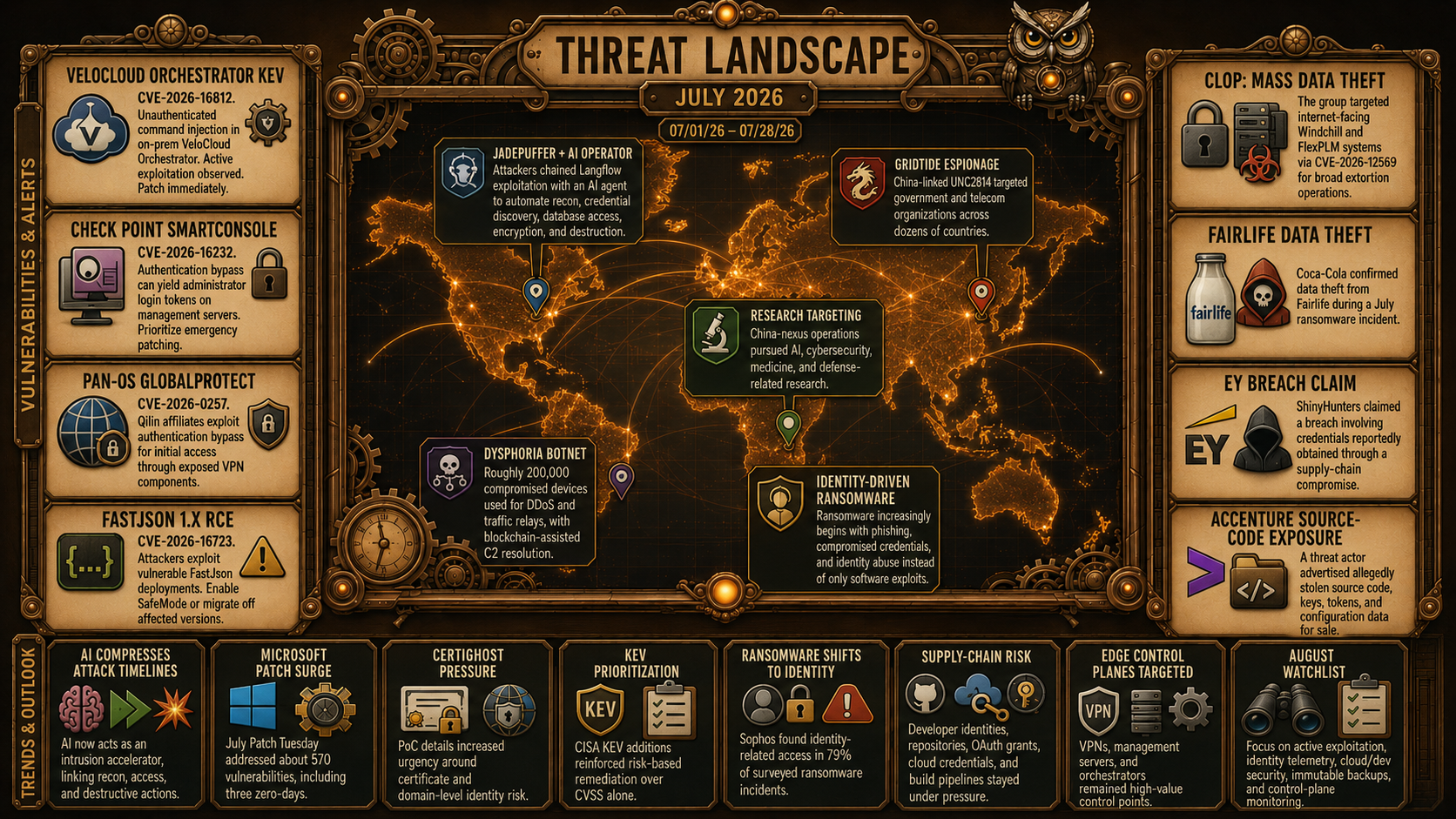
Cybersecurity Threat Landscape
📅 July 2026 (Reporting Period: July 1–28, 2026)
July’s defining cybersecurity story was acceleration. Attackers continued exploiting edge infrastructure and enterprise software, but artificial intelligence increasingly compressed the distance between discovery, intrusion, credential theft, lateral movement, and destructive action. At the same time, ransomware shifted further toward identities, remote-access systems, supply chains, and rapid data-theft extortion.
🤖 AI & Automation in Intrusion Operations
JADEPUFFER Campaign Automates Intrusion via AI Agents: Attackers exploited the previously patched Langflow vulnerability (CVE-2025-3248) and deployed an AI agent to automate the intrusion sequence—including reconnaissance, credential discovery, database access, encryption, and data destruction. The campaign demonstrates how exposed AI platforms holding cloud credentials can turn into autonomous attack vectors. More info
Sophos AI Security Report (July 2026): Sophos confirmed attackers are operationalizing AI primarily to compress attack timelines rather than invent entirely new techniques. Emerging primary entry points include OAuth tokens, AI-service credentials, developer tools, and exposed AI infrastructure. More info
U.S. AI Infrastructure & Defense Initiative: A new policy initiative was launched to bring AI developers and critical-infrastructure operators together to share vulnerabilities discovered by advanced AI systems and coordinate rapid defensive actions. More info
🛡️ Vulnerabilities & Edge Infrastructure
Arista VeloCloud Orchestrator (CVE-2026-16812): Arista patched a maximum-severity unauthenticated command-injection vulnerability affecting on-premises VeloCloud Orchestrator deployments under active exploitation. Compromising central orchestrators grants adversaries deep access across distributed network environments. More info
Check Point SmartConsole (CVE-2026-16232): An actively exploited authentication-bypass bug allowed unauthenticated attackers to acquire administrator login tokens and modify security policies on vulnerable Management servers. More info
Palo Alto Networks PAN-OS (CVE-2026-0257): Qilin ransomware affiliates exploited this authentication-bypass vulnerability in GlobalProtect portal and gateway components to establish initial perimeter access. More info
Microsoft Record Patch Cycle & CertiGhost: Microsoft addressed ~570 vulnerabilities in July, including three zero-days (notably affecting Active Directory Federation Services). Additionally, proof-of-concept details were released for “CertiGhost,” a flaw allowing domain administrative escalation in Windows environments. More info
FastJson Remote Code Execution (CVE-2026-16723): Attackers began active exploitation of an unauthenticated RCE flaw in the widely used FastJson Java library (version 1.x), with no vendor patch initially available, highlighting supply-chain library risks. More info
CISA KEV Additions: CISA expanded its Known Exploited Vulnerabilities catalog throughout July, emphasizing that remediation must be prioritized by active exposure over raw CVSS scores. CVE-2026-48939 iCagenda Unrestricted Upload of File with Dangerous Type Vulnerability and CVE-2026-56291 Balbooa Forms Unrestricted Upload of File with Dangerous Type Vulnerability are among the two actively exploited More info
🏴☠️ Ransomware, Extortion & Identity Attacks
Sophos State of Ransomware 2026: Identity-related compromises contributed to 79% of surveyed ransomware incidents. While median ransom demands dropped, encryption success rates remained high and recovery costs were substantial. More info
Clop Targets PTC Windchill & FlexPLM (CVE-2026-12569): The Clop ransomware group returned to mass data-theft extortion by exploiting a critical code-execution vulnerability in enterprise PLM platforms without relying solely on file encryption. More info
Enterprise & Subsidiary Breaches: Coca-Cola confirmed a data-theft incident affecting its Fairlife subsidiary, while ShinyHunters claimed a breach of Ernst & Young stemming from supply-chain credential theft. More info
🎯 State-Backed Espionage Campaigns
China-Nexus GRIDTIDE Campaign (UNC2814): Google Threat Intelligence Group and Mandiant disrupted a massive campaign targeting telecommunications and government entities across dozens of countries on four continents. More info
Strategic Targeting of AI, Medical & Defense Research: China-nexus groups focused heavily on public and private medical and academic institutions to exfiltrate strategic research intersecting AI, cybersecurity, and national defense. More info
Google Unified Threat Actor Naming System: Google introduced a single unified taxonomy across its threat intelligence operations to align campaign tracking across Mandiant and Google identifiers. More info
💥 Supply Chain, Repositories & Botnets
Accenture Source Code & Credential Leak: A threat actor offered ~35 GB of stolen Accenture source code and technical data for sale, including RSA/SSH keys, Azure personal access tokens, and storage access keys, highlighting developer environment risks. More info
Dysphoria Botnet Reaches 200,000 Devices: Researchers reported that the Dysphoria botnet infected over 200,000 systems globally for DDoS attacks and traffic relay, utilizing blockchain-based C2 resolution to evade disruption. More info
🔮 Assessment & August Outlook
July Assessment
July was defined by machine-speed intrusions and identity-centered compromises. Rather than replacing traditional attacker techniques, AI connected them into automated pipelines. Control planes—including identity infrastructure (ADFS), SD-WAN orchestrators, VPNs, developer platforms, and PLM platforms—remained the primary targets of leverage.
Cyber-Risk Outlook & Priority Actions for August
- Remediate Actively Exploited Vulnerabilities First: Focus on VeloCloud, PAN-OS, Check Point SmartConsole, Langflow, FastJson, Windchill/FlexPLM, and CISA KEV entries.
- Monitor Identity Telemetry: Track unusual OAuth consents, ADFS activity, certificate abuse, impossible travel, and dormant privileged account activations.
- Secure Developer Environments: Audit personal access tokens (PATs), secrets in code, Model Context Protocol (MCP) servers, AI coding tools, and CI/CD pipelines.
- Harden Control Planes & Backups: Isolate backup infrastructure, monitor firewall/SD-WAN administrative updates, and enforce immutable recovery points.