Cybersecurity Threat Landscape — October 2026
October 2026 cybersecurity threat landscape analysis covering AI-driven intrusion at machine speed, supply chain compromises, core web infrastructure flaws, and network control-plane attacks.
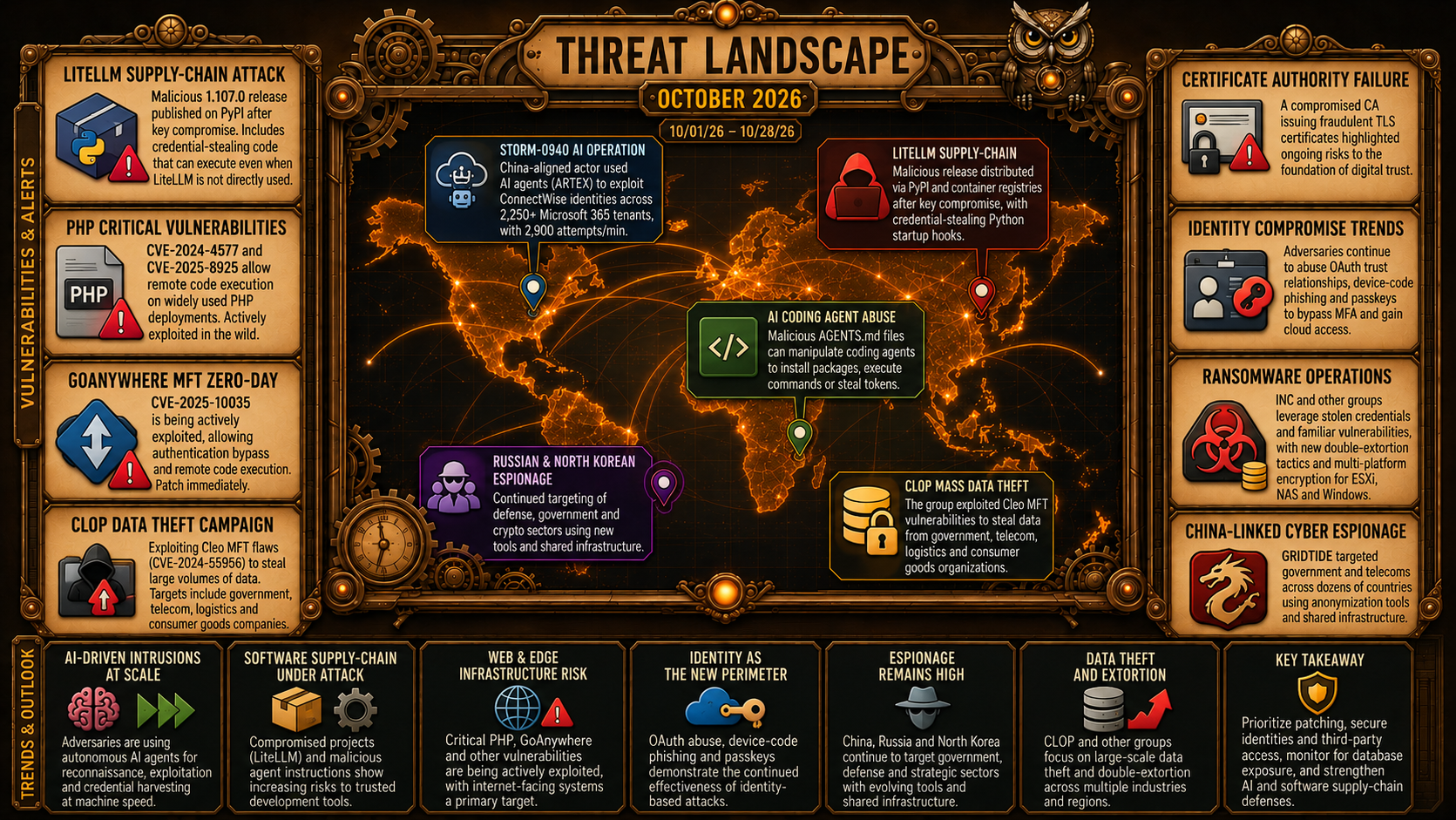
Cybersecurity Threat Landscape
📅 October 2026 (Reporting Period: October 1–28, 2026)
October’s cybersecurity landscape was defined by a dangerous convergence: AI-driven intrusion at machine speed, the compromise of trusted software and cloud identities, and renewed attacks against the infrastructure that holds modern organizations together. Attackers are increasingly targeting systems whose compromise can open doors into many others, leveraging autonomous agents, software supply chains, and network control planes.
🤖 AI & Automation in Intrusion Operations
Storm-0940 Uses ARTEX AI Agentic Framework: Microsoft Threat Intelligence attributed a major cloud supply-chain campaign to China-aligned Storm-0940. Using compromised ConnectWise Cloud Backup application identities, the actor attempted automated password spraying across 2,250+ M365 tenants peaking at 2,900 attempts/minute, achieving privileged cloud access in under three hours. More info
CyberStrikeAI Coordinates 44 Specialized AI Agents: TrendAI disclosed operations targeting Japanese entities using CyberStrikeAI, an offensive framework coordinating 44 AI agents for automated reconnaissance, vulnerability validation, exploitation, C2, and evidence collection across at least 19 organizations. More info
Malicious Instruction Injection in AI Coding Agents: Researchers demonstrated how malicious
AGENTS.mdinstruction files in repositories can trick AI coding agents (such as Codex and Claude Code) into executing unauthorized commands, installing packages, or leaking authentication tokens. More info
🛡️ Vulnerabilities & Edge Infrastructure
PHP2Shell Emergency Web Infrastructure Flaws (CVE-2026-109618 & CVE-2026-109619): Publicly disclosed critical request-handling flaws in PHP core enable unauthenticated remote code execution. Cisco Talos observed exploitation within hours, and CISA added both to its KEV catalog due to broad exposure across WordPress, Drupal, Magento, and Laravel. More info
Arista VeloCloud Orchestrator SQLi (CVE-2026-114625): Arista patched an actively exploited SQL injection vulnerability in VeloCloud Orchestrator that allows low-privilege authenticated attackers to escalate to superuser access over central SD-WAN management. More info
PEERSTITCH ARM64 Implant Targets FortiGate Firewalls: Palo Alto Unit 42 revealed that an intrusion into telecom FortiManager infrastructure allowed attackers to extract configuration and cryptographic data for 500+ managed firewalls and deploy stealthy ARM64 implants. More info
Record October Microsoft Patch Tuesday: Microsoft addressed 1,411 vulnerabilities (70 Critical, 3 zero-days). Crucially, CVE-2026-96951 in Windows Shell was actively exploited to bypass Mark of the Web (MoTW) protections. More info
eMudhra CA Weakened Keys Compromise Trust: Cisco Talos warned that eight intermediate certificates were generated with severely weakened keys, forcing browser vendors and software distributors to distrust affected root hierarchies. More info
🏴☠️ Ransomware, Extortion & Identity Attacks
SafePay Ransomware Expands via Infrastructure Vulnerabilities: CISA, the FBI, and international partners issued a joint advisory on SafePay ransomware, which compromised 600+ critical infrastructure victims across multiple continents using stolen credentials and edge flaws. More info
Capcom ID Breach Exposes 11.7 Million Email Accounts: Japanese publisher Capcom confirmed an unauthorized access incident exposing 11.7M user email addresses and metadata, creating high-value targets for follow-on phishing campaigns. More info
Bitget Crypto Exchange $387.5M Theft Investigation: Bitget revealed that a September theft of $387.5 million stemmed from a zero-day vulnerability in third-party security software, granting unauthorized access to internal wallet controls across multiple blockchains. More info
Brazil Central Bank Reports Financial Cyber Incident Surge: Brazil’s Central Bank reported 99 cybersecurity incidents through September 2026 (68 fraud-related), surpassing 2025’s total and prompting tighter Open Finance governance and data-sharing rules. More info
🎯 State-Backed Espionage Campaigns
APT28 (Fancy Bear) Targets NATO Defense Sector: Russian state-sponsored actors targeted naval shipbuilders, military aircraft manufacturers, and law enforcement across NATO nations, deploying HOOKEDGE loaders and persistent SSH tunnels. More info
APT41 Deploys BlackX UEFI Bootkit: Kaspersky identified the BlackX bootkit deployed against Central Asian diplomatic entities, exploiting Baton Drop Secure Boot bypasses to gain persistent execution beneath operating-system controls. More info
North Korean Lazarus Group Operation FlashHole: Lazarus targeted South Korean construction and tech firms by abusing financial security software, utilizing the Cubridge framework with ML-KEM-1024 post-quantum cryptography. More info
Escalating Cyber Pressure on Ukrainian Infrastructure: Ukrainian officials reported Russian cyberattacks matching the intensity of physical strikes against energy targets, including attacks against ten Kyiv data centers alongside rising AI-assisted threats. More info
💥 Supply Chain, Engineering & AI Ecosystems
- Warp Developer Terminal Telemetry Exposure: Developer tool provider Warp disclosed a vendor infrastructure breach impacting ~1% of users, potentially exposing AI-agent decision logs and operational telemetry. More info
🔮 Assessment & November Outlook
October Assessment
October was defined by machine-speed operations against trusted infrastructure. Autonomous AI agents executed structured offensive workflows with limited human involvement, while adversaries shifted heavily toward trusted dependencies (LiteLLM, eMudhra, FortiManager, ConnectWise, and AI agent instruction files). Compromising non-human identities and central management layers continues to give attackers maximum downstream leverage.
Cyber-Risk Outlook & Priority Actions for November
- Emergency Patching for Core Web & Edge Infrastructure: Immediately apply fixes for PHP2Shell (CVE-2026-109618 & CVE-2026-109619), Arista VeloCloud, and actively exploited CISA KEV flaws.
- Audit & Restrict Non-Human Cloud Identities: Review OAuth application permissions, service principal credentials, and API keys; automated cloud intrusions unfold in hours.
- Secure the AI & Developer Ecosystem: Inspect AI gateway dependencies (LiteLLM), audit local repository configuration files (
AGENTS.md), and rotate secrets exposed in build/telemetry environments. - Implement High-Speed Incident Containment: Connect high-confidence detections directly to rapid session revocation, application credential disablement, and management system isolation.