Cybersecurity Newsfeed - 11/11/26
Daily cybersecurity news covering vulnerabilities, adversaries, trends, breaches, and other notable security developments.
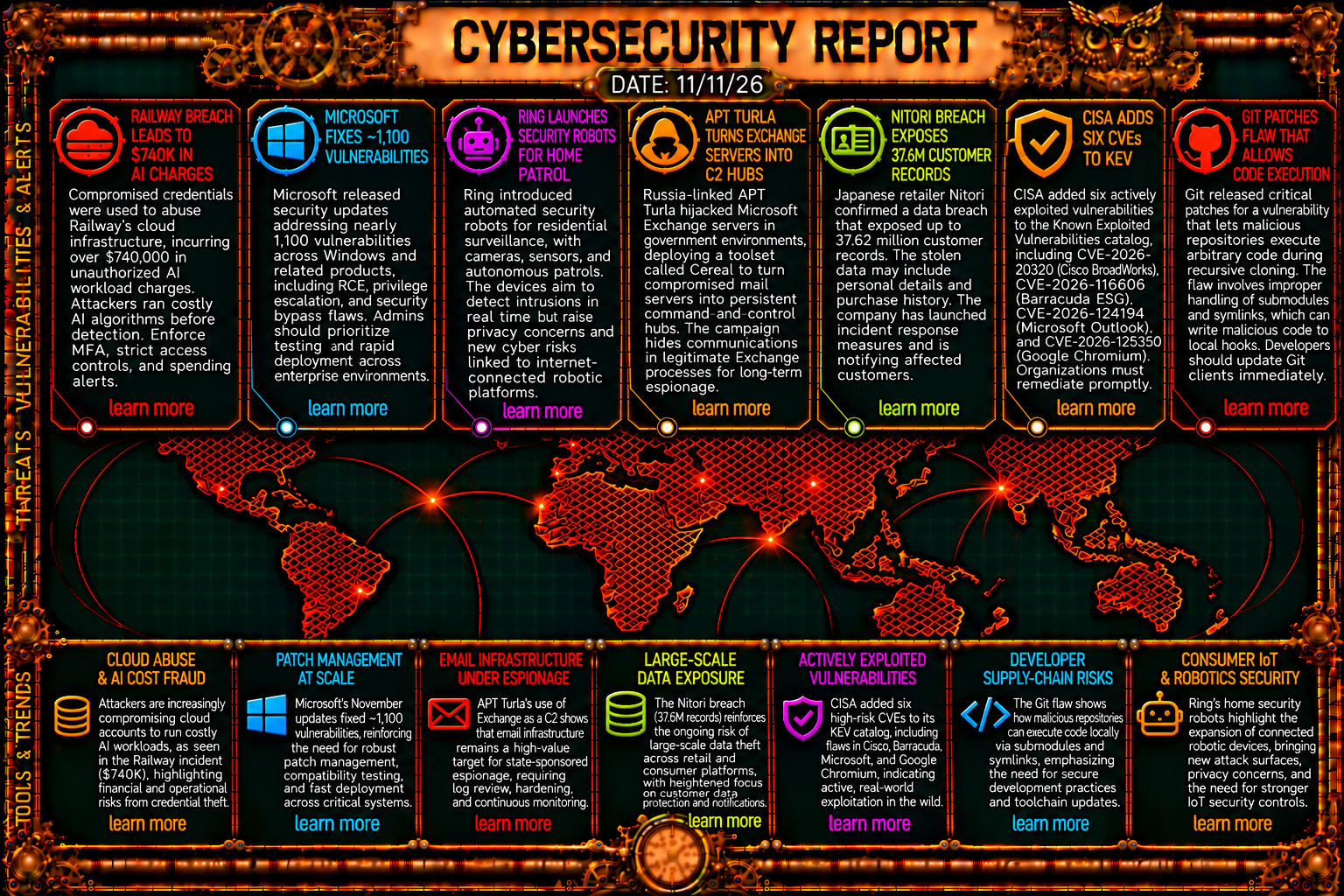
Cybersecurity Newsfeed
📅 11/11/26
🛡️ Vulnerabilities
Microsoft Fixes Nearly 1,100 Security Vulnerabilities: Microsoft released its latest security updates addressing nearly 1,100 vulnerabilities across the Windows operating system ecosystem and related software. The massive patch rollout addresses remote code execution, privilege escalation, and security feature bypass vulnerabilities. System administrators are urged to prioritize testing and deploying the patches, given the heightened risk of exploitation targeting unpatched enterprise endpoints and cloud workloads. More info
Exploited Outlook Zero-Day Among 1,094 Flaws Patched by Microsoft: Microsoft’s latest security release addresses 1,094 vulnerabilities, featuring an actively exploited Outlook zero-day flaw that allows execution without user interaction. The security bundle addresses numerous remote code execution and privilege escalation bugs across the ecosystem. Immediate patching of affected email clients and endpoints is strongly recommended. More info
CISA Adds Six Known Exploited Vulnerabilities to Catalog: The Cybersecurity and Infrastructure Security Agency added six vulnerabilities actively exploited in real-world cyberattacks to its Known Exploited Vulnerabilities catalog. The vulnerabilities include CVE-2026-20320 (Cisco BroadWorks XML External Entity reference flaw), CVE-2026-116606 (Barracuda Email Security Gateway authentication bypass), CVE-2026-124194 (Microsoft Outlook interaction bypass), and CVE-2026-125350 (Google Chromium use-after-free error). Federal agencies and private organizations are mandated to remediate these flaws promptly to prevent network compromise. More info
Hackers Exploit Critical Xen Orchestra Auth Bypass Flaw: Threat actors are actively exploiting a critical zero-day authentication bypass vulnerability in Xen Orchestra to gain administrative privileges and hijack managed XCP-ng virtual machine servers. Attackers utilize compromised access to deploy backdoor implants, persistence scripts, and cryptominers. System administrators must immediately update instances or restrict public network exposure. More info More info Git Patches Flaw That Lets Malicious Repositories Execute Code: Git released critical security patches resolving a vulnerability that enables malicious repositories to execute arbitrary code on developer systems during recursive cloning operations. The flaw stems from improper handling of submodules and symlinks, allowing attackers to write malicious code into local environment hooks. Developers and platform administrators are advised to update Git client versions immediately. More info
SGLang RCE Exploit Breaches NEAR AI: A remote code execution vulnerability in SGLang was exploited to breach NEAR AI infrastructure, allowing attackers to compromise data across 18 AI agents and approximately 100 user accounts. The exploit exposed chat histories, agent configurations, and API credentials. Organizations utilizing open-source LLM serving frameworks must audit exposed endpoints and apply sandbox isolations. More info
Hackers Exploit Barracuda Email Security Gateway Flaws to Get Root Access: Threat actors actively leverage authentication bypass vulnerabilities in Barracuda Email Security Gateway appliances to execute arbitrary commands with elevated root access. The compromise allows attackers to monitor mail flow and infiltrate internal networks. Organizations must apply emergency vendor patches and inspect appliances for indicators of compromise. More info
Binance Warns of iOS Flaw That Could Leak Crypto Wallet Secrets: Binance issued a security alert warning that vulnerabilities in specific iOS releases permit malicious third-party applications to bypass sandbox boundaries and read sensitive local files, exposing cryptocurrency seed phrases and private keys. Apple users are advised to isolate secret stores and verify application permissions. More info
SAP Patches Four Maximum-Severity Security Vulnerabilities: SAP released security updates remediating four maximum-severity vulnerabilities in key enterprise components, including SAP Gateway. The flaws allow unauthenticated remote attackers to bypass access controls, spoof server components, and achieve complete system compromise. Immediate patching is essential for enterprise landscape security. More info
Apple Patches iMessage Group Chat Vulnerability: Apple published security patches addressing a logic flaw within iMessage group chat handling that could allow unauthorized data access or service disruption via malicious message payloads. Users across iOS, iPadOS, and macOS platforms are instructed to update their operating systems promptly. More info
Google Patches Eighth Chrome Zero-Day Exploited in Attacks This Year: Google issued an out-of-band security fix for Google Chrome, patching a zero-day use-after-free vulnerability in the Chromium browser engine that is being actively exploited in targeted attacks. Desktop users must immediately apply browser updates across operating systems to mitigate exploitation risks. More info
- N-able Takes Cloud Platform Offline After 30-Plus Zero-Days Published: IT management software provider N-able temporarily shut down its cloud management platform after security researchers publicly released details and exploit code for over 30 zero-day vulnerabilities. The proactive platform shutdown aims to prevent widespread exploitation while emergency patches are developed. More info
🎯 Adversaries
Russia-Linked APT Turla Turned Exchange Servers Into Their Own Control Room: Russian state-sponsored threat group Turla hijacked Microsoft Exchange servers in government environments, deploying a specialized toolset dubbed Cereal to convert affected mail infrastructure into durable command-and-control hubs. By concealing communication within legitimate Exchange processes, Turla maintains long-term persistence and internal data collection without relying on external infrastructure. Security experts emphasize auditing Exchange server logs and enforcing rigorous endpoint telemetry. More info
Three China-Nexus Espionage Campaigns Linked Through Sparrow Ecosystem: Threat intelligence researchers linked three separate cyber espionage campaigns targeting government and telecom sectors in Latin America to China-nexus threat actors using the shared “Sparrow” malware ecosystem. The campaigns deploy custom Linux backdoors (SparrowShell), raw input keyloggers, and LSASS credential dumpers to establish persistent stealth access. Defensive teams are advised to monitor for DNS tunneling and unauthorized DLL sideloading activity. More info
Hackers Exploit Trusted AWS Access to Breach Multiple Cloud Environments: Attackers leveraged compromised IAM credentials from a third-party big data platform’s AWS environment to pivot into and exfiltrate data from multiple customer cloud environments. The incident highlights cross-account trust security risks inherent in cloud integrations. Organizations are advised to enforce external ID parameters, strict IAM role boundaries, and continuous cross-account monitoring. More info
Attackers Exploit AhsayCBS Flaws to Deploy Python Backdoor: Threat actors are exploiting critical vulnerabilities in AhsayCBS backup software to deploy evasive Python-based backdoors across victim networks. The exploit sequence grants remote access, bypasses sandbox security controls, and executes persistent malicious scripts on host backup servers. Organizations using Ahsay software are urged to apply vendor updates immediately. More info
Blind Eagle Uses Fake Court Notices to Deploy Malware: The Blind Eagle threat group initiated a phishing campaign targeting organizations with fake judicial court notices. The phishing emails carry malicious attachments that deliver remote access trojans (RATs) to extract credentials and financial telemetry from compromised systems. Organizations should reinforce email gateway filters and user awareness training. More info
📈 Trends
Railway Breach Leads to $740,000 in Fraudulent AI Charges: A cyber incident involving compromised credentials led attackers to misuse cloud infrastructure linked to railway operations, incurring over $740,000 in unauthorized artificial intelligence workload charges. The breach underscores the growing financial risks associated with cloud credential compromise and unmonitored compute resources. Attackers leveraged high-performance cloud environments to process costly AI algorithms before security teams detected the anomalous activity. Organizations are urged to enforce strict identity management, multi-factor authentication, and automated spending alerts to prevent rogue infrastructure usage. More info
Microsoft Patch Tuesday November 2026 Security Update Review: Qualys published a comprehensive security analysis reviewing Microsoft’s November Patch Tuesday updates. The review details critical elevation of privilege, remote code execution, and security feature bypass vulnerabilities affecting core Windows components, Office applications, and kernel drivers. Risk mitigation recommendations emphasize immediate patching protocols and compensating network controls. More info
💥 Breaches & Leaks
Japanese Furniture Giant Nitori Says Hackers Stole 37.6M Customer Records: Major Japanese home retailer Nitori confirmed a severe data breach involving unauthorized access to its internal network servers, exposing up to 37.62 million customer records. Stolen data may include personal user details and purchase records, though investigation into the full incident scope remains ongoing. The retailer has initiated security protocols and customer notification procedures. More info
Fireworks AI Breach Widens to Expose Cloud Credentials: Investigative updates into the Fireworks AI security incident reveal expanded data exposure involving cloud infrastructure credentials and internal API tokens. Compromised credentials allow unauthorized access to artificial intelligence model development environments and user data repositories. Affected users must rotate key pairs and audit access logs. More info
Sega Newsletter Data Breach Exposes 22 Million Email Addresses: Video game publisher Sega experienced a data security breach that resulted in the exposure of approximately 22 million subscriber email addresses from its newsletter distribution server. The compromised data raises spear-phishing risks for impacted users. More info
York University Breach Exposed Personal Information Dating to 2007: York University confirmed a historical data security incident involving unauthorized access to institutional databases storing sensitive personal records of students and faculty dating back to 2007. Compromised information includes identification details and administrative records. Affected individuals are being provided identity protection support services. More info
📚 Others
- Ring Robots Ready to Patrol Paranoids’ Pads: Ring announced its latest automated security patrol robots designed for home surveillance and physical perimeter monitoring. Operating with integrated sensors, cameras, and automated movement patterns, the devices aim to provide continuous real-time intrusion detection for residential properties. The technology raises ongoing discussions regarding consumer privacy, physical automated security measures, and the potential cyber risks inherent in internet-connected robotic platforms. More info