Cybersecurity Newsfeed - 13/08/26
Daily cybersecurity news covering vulnerabilities, adversaries, trends, breaches, and other notable security developments.
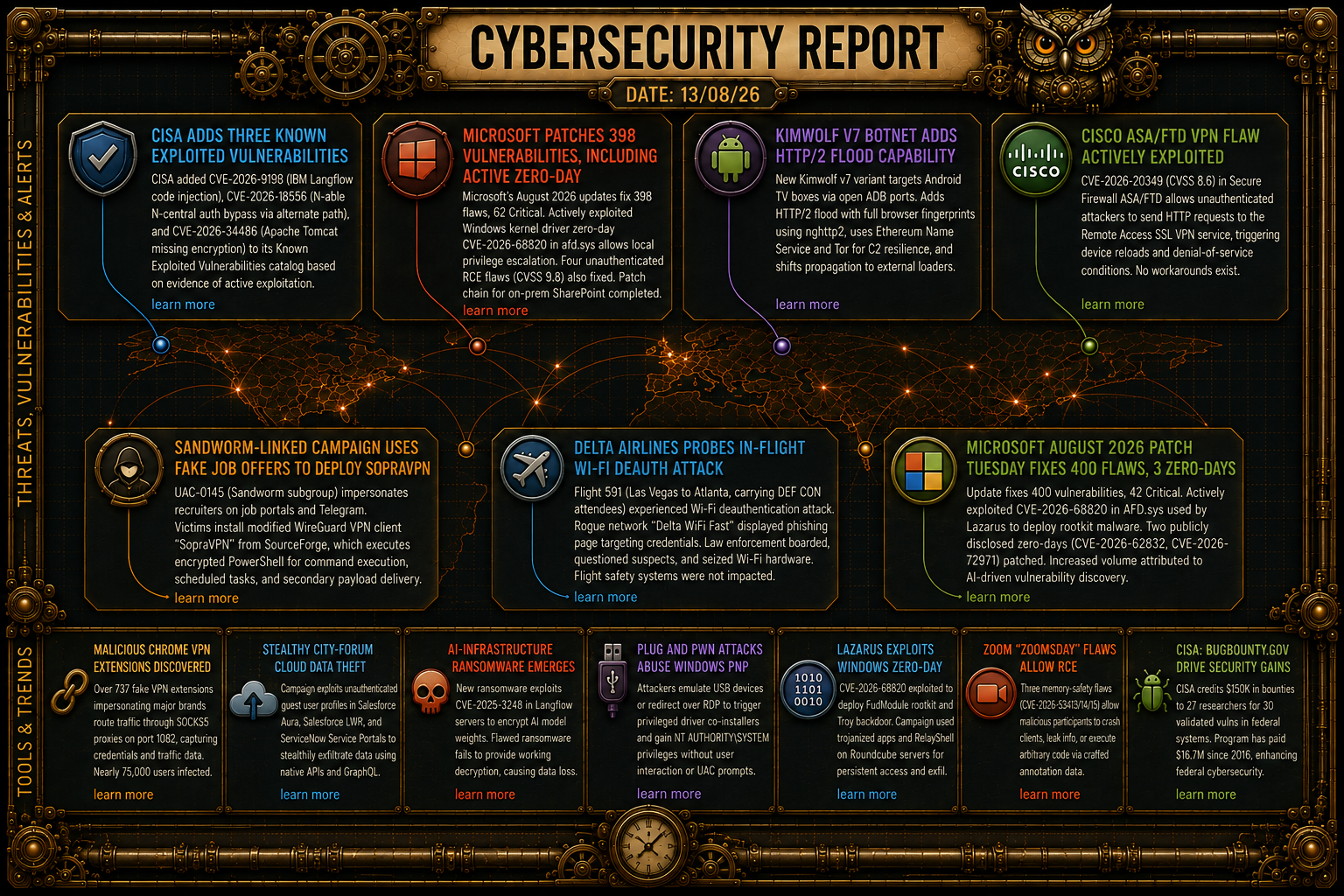
Cybersecurity Newsfeed
📅 13/08/26
🛡️ Vulnerabilities
Microsoft Patch Tuesday Fixes 400+ Flaws & Zero-Days: Microsoft’s August 2026 security release addresses up to 421 vulnerabilities (62 Critical), including an actively exploited privilege escalation flaw in afd.sys(CVE-2026-68820), a 9.8 CVSS RCE in Windows Deployment Services TFTP (CVE-2026-62893), a wormable DNS Server vulnerability (CVE-2026-62878), and User Profile Service flaws. System administrators are urged to patch immediately. More infoMore info More info “ShieldBreak” Zero-Day Bypasses Microsoft Defender: A new local privilege escalation exploit called ShieldBreak bypasses previous fixes (CVE-2026-50656) by abusing Cloud Filter API (
cfapi) user-mode callback hooks during cloud-hydration scans to gain fullNT AUTHORITY\SYSTEMprivileges on Windows endpoints. More infoCritical VMware vCenter Traversal Flaw (CVE-2026-59310): Attackers are actively exploiting a critical directory traversal bug (CVSS 9.8) in VMware vCenter Server to execute arbitrary code and establish persistent reverse SSH tunnels, alongside increased scanning for SAML SSO bypasses (CVE-2026-59309). More info
SharePoint Auth Bypass Exploited in the Wild (CVE-2026-55040): A PoC exploit for SharePoint’s JWT token validation pipeline is being actively weaponized to hijack administrator sessions, while CISA confirmed another SharePoint RCE (CVE-2026-45659) is being deployed in ransomware campaigns. More info
“Zoomsday” Memory-Safety Bugs Hit Zoom: Three flaws (CVE-2026-53413, CVE-2026-53414, CVE-2026-53415) in Zoom’s annotation parsing logic allow malicious meeting participants to trigger memory corruption, causing client crashes, info leaks, or arbitrary code execution across Windows, macOS, Linux, and VDI platforms. More info
Maximum-Severity Code Execution Flaw in SAP Commerce Cloud (CVE-2026-58231): SAP patched a CVSS 10.0 flaw caused by missing authorization and validation on a default authentication client, permitting unauthenticated remote takeover of application components. More info
- Ivanti Patches Multiple Endpoint Manager Flaws: Ivanti released updates addressing high-severity flaws in Endpoint Manager (EPM) version 2024 SU7 (CVE-2026-18129, CVE-2026-18125, CVE-2026-18127) that could lead to credential exposure, agent DoS, or recording manipulation. More info
🎯 Adversaries
Lazarus Exploits Windows Zero-Day in Defense Cyberespionage: North Korea-linked Lazarus group weaponized a zero-day in afd.sys(CVE-2026-68820) during Operation Dream Job. Approaching defense and aerospace targets with fake job offers, they deployed a 17-command backdoor named “Troy”, MISTPEN downloaders, FudModule rootkits bypassing Smart App Control, and RelayShell web shells on compromised Roundcube webmail servers. More infoMore info More info Sandworm Targets IT Administrators with Trojanized “SopraVPN”: Russia’s APT44 (Sandworm) conducted fake job interviews over Zoom to trick IT admins into installing a trojanized WireGuard VPN client hosted on SourceForge, delivering hidden obfuscated PowerShell payloads for endpoint persistent access. More info
Sandworm Attack Sabotaged Polish Power Plant: A post-mortem by CERT.PL details how Sandworm breached a combined heat and power plant via a wind farm firewall and SSH tunnels through a private APN network, manipulating WAGO and Siemens PLCs to force a shutdown of steam turbines. More info
“City-Forum” Campaign Exploits Guest Profiles in Cloud Services: Threat actors are abusing unauthenticated guest access on Salesforce Aura/LWR and ServiceNow Service Portals using a custom Go tool to extract massive amounts of telecom, financial, and government enterprise data via search endpoints and GraphQL queries. More info
Gunra Ransomware Exploits Fortinet Vulnerabilities: Authorities warn that Gunra ransomware affiliates are leveraging Fortinet flaws (CVE-2024-55591 and CVE-2025-24472) to gain super-admin access, bypass MFA, wipe backups, and exfiltrate terabytes of data from Microsoft 365 environments. More info More info DeadLock Ransomware Leverages Polygon Blockchain: DeadLock ransomware is adopting a decentralized C2 setup by storing configuration data and victim leak logs in Polygon smart contracts, while hosting exfiltrated corporate files on Wasabi cloud storage. More info
Ransomware Targeting AI Infrastructure Brick Model Weights: Attackers are exploiting an unauthenticated endpoint (CVE-2025-3248) in Langflow servers to execute Python code and encrypt critical AI model checkpoints. Flaws in the ransomware binary render affected machine learning models permanently unrecoverable. More info
Kimwolf v7 Android Botnet Mimics Chrome via Protocol Fingerprinting: An upgraded variant of Kimwolf targets Android TV boxes using HTTP/2 DDoS floods, multi-tier C2 via Ethereum Name Service (ENS) resolution, and open Android Debug Bridge (ADB) ports for propagation. More info
WindRelay Android NFC Relay Malware Deployed in Banking Scams: Group-IB uncovered live-call financial scams delivering SpyNote RAT and WindRelay malware to Android devices, allowing fraudsters to intercept contactless NFC payment card data and perform real-time unauthorized transactions. More info
- 75,000 Users Infected by 737 Malicious Chrome VPN Extensions: Socket researchers discovered a campaign leveraging hundreds of fake Chrome extensions (impersonating NordVPN, Proton VPN, and Cloudflare 1.1.1.1) to route victim HTTP traffic and capture credentials via SOCKS5 proxies on port 1082. More info
📈 Trends
“Plug and Pwn” Techniques Abuse Windows Plug and Play: Researchers demonstrated local privilege escalation to
NT AUTHORITY\SYSTEMby emulating fake USB hardware via FaceDancer or RDP USB redirection, tricking Windows into executing vulnerable vendor co-installers without UAC prompts. More infoFake IT Workers and North Korean Remote Applicants Infiltrate Enterprise Hiring: Security experts warn against fraudulent remote job applicants using AI-generated profiles, forged identities, and local proxy “laptop farms” to bypass vetting, exfiltrate IP, or extort employers. More info
WhatsApp & Signal Upgrade Messaging Privacy Features: WhatsApp launched on-device “Scam Alert” ML detection for messages from unknown senders verified via Cloudflare-signed ledgers, while Signal introduced Automatic Key Verification using third-party audited key transparency logs to neutralize MITM attacks. More info More info
💥 Breaches & Leaks
- FBI & NCAA Warn of Credential Harvester Attacks Targeting Media Accounts: Law enforcement issued warnings regarding account compromise campaigns against student-athletes and adults using phishing links and fake verification lures to steal explicit photos for extortion and illicit market distribution. More info