Cybersecurity Newsfeed - 29/06/26
Daily cybersecurity news covering vulnerabilities, adversaries, trends, breaches, and other notable security developments.
Cybersecurity Newsfeed
📅 29/06/26
🛡️ Vulnerabilities
Linux Kernel Crypto AEAD Local Privilege Escalation (CVE-2026-31431): Security researchers disclosed “DirtyClone” (also known as “Copy Fail”), a severe use-after-free flaw within the Linux kernel’s crypto AEAD interface (
algif_aead). The logic vulnerability stems from a failure to manage memory references during in-place encryption and decryption operations when source and destination buffers overlap. Local unprivileged attackers can exploit this to perform a controlled 4-byte write into the page cache, corrupting memory representations of privileged binaries to elevate privileges to root. More infoCisco Unified Communications Manager SSRF (CVE-2026-20230): CISA added a high-severity Server-Side Request Forgery vulnerability affecting Cisco Unified Communications Manager and Session Management Edition to its Known Exploited Vulnerabilities catalog. Stemming from improper input validation in the WebDialer service, unauthenticated remote attackers are actively exploiting this flaw in the wild to write malicious files to the underlying operating system and achieve root-level remote code execution. More info
Linux Kernel Traffic Control pedit COW Exploit: A newly disclosed Linux kernel exploit targets a flaw within the Traffic Control network subsystem’s packet editing action module. By forcing an unstable state within memory tracking structures during memory-mapped Copy-on-Write operations, local unprivileged users can manipulate network packet attributes to achieve arbitrary code execution at the kernel level and escalate privileges to root. More info
Linux Kernel UDP Socket Splicing Flaw (CVE-2026-43284, CVE-2026-43500): Further technical details emerged regarding a local privilege escalation exploit chain dubbed “Dirty Frag.” The flaw occurs when the IPv4 and IPv6 datagram append paths fail to properly set memory flags when splicing pages into UDP socket buffers, enabling an ESP-in-UDP packet to execute a fast-path decryption over shared memory, allowing local attackers to overwrite critical kernel memory segments and gain root access. More info
Synology MailPlus Server Vulnerabilities: Multiple input validation flaws discovered in Synology MailPlus Server pose a threat to enterprise perimeters. The bugs could allow remote, unauthenticated attackers to execute arbitrary shell commands on vulnerable network-attached storage devices or trigger severe denial-of-service conditions. More info
🎯 Adversaries
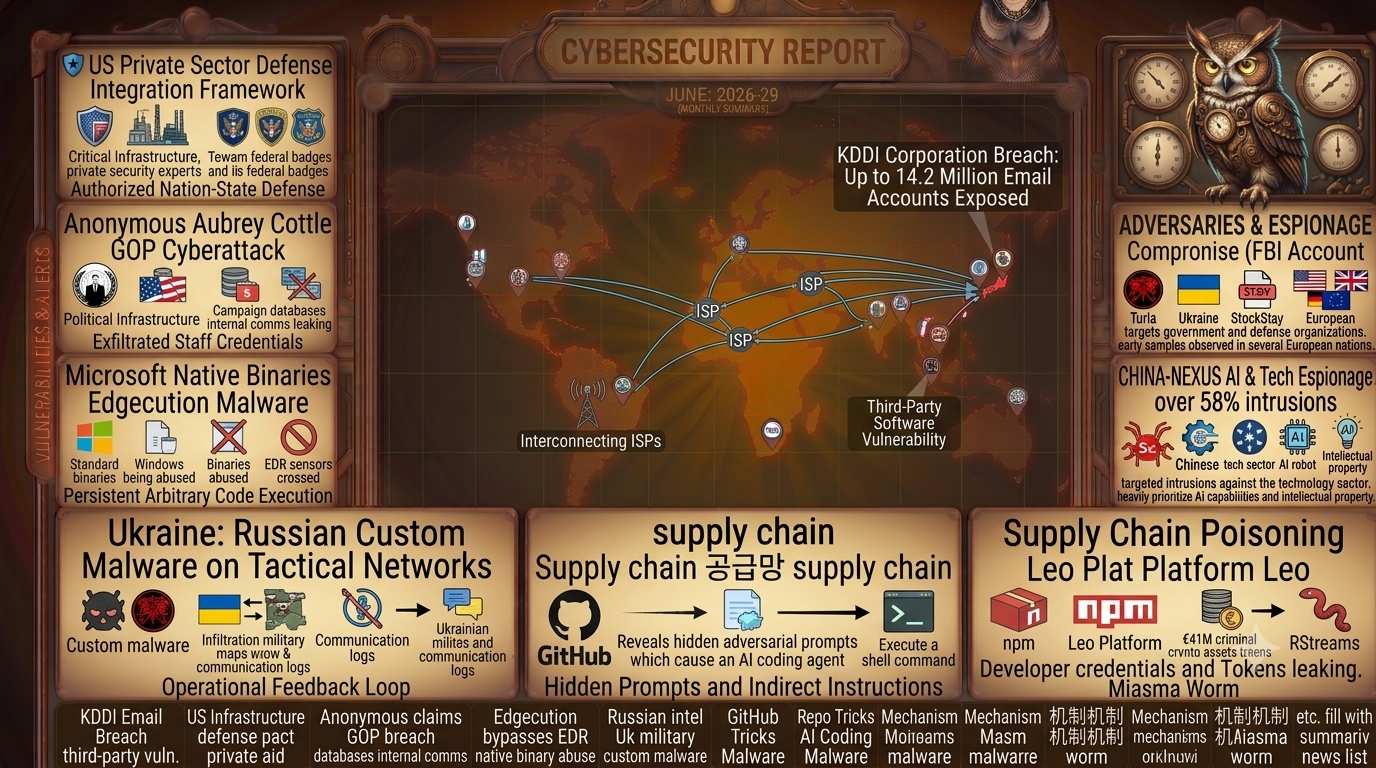
Edgecution Malware Exploits Native Microsoft Binaries: A sophisticated new malware strain dubbed “Edgecution” utilizes trusted native binaries and system administrative tools (“living off the land”) to achieve persistence and execute arbitrary payloads. This strategy allows it to bypass conventional signature-based EDR tools, establish an encrypted C2 channel, and exfiltrate targeted system metadata. More info
Russian Actors Deploy Tailored Espionage Tools Against Ukraine: Ukrainian intelligence reported that Russian state-sponsored threat groups are leveraging compromised legitimate software updates and targeted spear-phishing campaigns to deliver custom malware into local military tactical networks. The operation intercepts real-time coordinates, data feeds, and internal strategic communications to support physical battlefield operations. More info
FBI Warns Russian Cyber Actors Target Signal Backup Keys: The FBI issued an alert warning that Russian intelligence cyber actors have shifted tactics to locate and exfiltrate local database decryption keys and backup files from physical device storage. Rather than breaking Signal’s end-to-end encryption protocol directly, this localized malware approach allows attackers to reconstruct historical chat histories offline. More info
WoodGnat Brokering Network Access for Ransomware Gangs: A cyber threat group designated as “WoodGnat” is acting as an initial access broker, selling compromised corporate network access directly to prominent ransomware syndicates. The group heavily utilizes the “Mistic RAT” to establish persistent footholds, harvest internal directory data, and disable localized security controls. More info
Chinese-Speaking APT Targets Critical Infrastructure with TinyRCT Backdoor: An advanced persistent threat group has deployed a remarkably compact backdoor named “TinyRCT” targeting critical infrastructure organizations across Asia. The malware utilizes a modular architecture designed to evade file-based detection mechanisms while focusing on long-term intelligence gathering, active directory credential harvesting, and network mapping. More info
Russian APT Groups Deploy StockStay Backdoor: A Russian-affiliated advanced persistent threat group has launched a targeted cyber-espionage campaign deploying a newly developed backdoor named “StockStay” against Ukrainian administrative targets. Delivered primarily via spear-phishing emails containing malicious attachments, the backdoor handles file system harvesting, keystroke logging, and secondary payload execution. More info
North Korea’s Gaslight Malware Weaponizes Adversarial Prompt Injection: A newly discovered macOS malware strain named “Gaslight,” attributed to North Korean state-sponsored actors, introduces an evasion technique targeting AI-assisted triage systems. The backdoor hides adversarial prompt injection instructions inside its file structure, forcing automated security tools and LLM-based analysis pipelines to misinterpret the file as benign or abort entirely. More info
📈 Trends
Adversarial Repo Prompts Compromise AI Coding Assistants: A novel supply chain attack methodology demonstrates how a superficially clean GitHub repository can compromise autonomous AI coding assistants. Hidden, adversarial prompts embedded within code documentation or comments trick the parsing LLM into executing malicious shell commands during routine code analysis or build simulations due to a lack of sandboxing in common AI development tools. More info
Miasma Campaign Poisons Over 20 npm Packages: A sophisticated open-source supply chain attack campaign named “Miasma” has poisoned popular npm packages, specifically targeting Leo Platform and RStreams distributions. The malicious packages contain components designed to harvest developer credentials and cloud environment keys, functioning like a worm by using stolen session tokens to compromise additional package repositories on GitHub. More info
Initiative Launches to Tackle Security of End-of-Life Open Source: The Commonhaus Foundation launched the Open Source Sustainability Initiative to address the mounting security risks associated with legacy, end-of-life open-source software. As automated AI tools accelerate vulnerability discovery faster than volunteers can patch them, the initiative aims to provide collaborative CVE remediation and compliance support for strict regulatory frameworks like PCI DSS 4.0 and DORA. More info
Poisoned Tenant Campaign Exploits OpenAI Invites: A highly targeted phishing campaign dubbed “Poisoned Tenant” leverages fraudulent OpenAI organization invitations to compromise enterprise technology and cybersecurity firms. Threat actors create deceptive workspaces mimicking legitimate corporations and issue membership invites through OpenAI’s authentic notification infrastructure, bypassing standard secure email gateways to trick users into inputting proprietary source code and sensitive data into compromised models. More info
💥 Breaches & Leaks
KDDI Data Breach Impacts 14.2 Million Email Accounts: KDDI Corporation disclosed a severe data breach exposing up to 14.2 million email accounts across six Japanese internet service providers. The incident was traced back to a vulnerability in an unnamed third-party software provider utilized by the telecommunications giant, elevating risks of targeted phishing campaigns and credential stuffing attacks against affected subscribers. More info
Anonymous Hacktivist Aubrey Cottle Targets Republican Party Infrastructure: Prominent activist and founder of the CyberGuerrilla group, Aubrey Cottle, claimed responsibility for a disruptive cyberattack targeting digital infrastructure associated with the Republican Party. The breach resulted in the defacement of several public-facing political domains and the alleged exfiltration of campaign databases containing donor details, internal communications, and staff credentials. More info
Academic Vendor Risks Highlighted by Wave of Third-Party Breaches: A wave of third-party data breaches targeting educational institutions highlights critical gaps in academic vendor risk management programs. Cybercriminals are increasingly bypassing hardened university networks by compromising secondary EdTech platforms and administrative contractors, leading to mass exposure of student records, financial information, and research data. More info
Polymarket Suffers $3 Million Supply Chain Hack: Decentralized prediction market platform Polymarket suffered a catastrophic supply chain compromise resulting in approximately $3 million stolen from customer accounts. Threat actors compromised a third-party JavaScript library integrated into the platform’s web interface, injecting a malicious script that dynamically altered transaction destinations and drained connected cryptocurrency wallets. More info
macOS Flaw Allows Users to Completely Disable Security Agents: Security researchers disclosed a structural logic flaw in macOS that allows local users with standard privileges to completely disable enterprise security agents. The vulnerability permits the unauthorized modification of system-level daemons, enabling a standard user account to shut down or block critical endpoint visibility tools including CrowdStrike Falcon and Kandji Endpoint Management without triggering standard operating system alerts. More info
⚖️ Governance & Law Enforcement
US Opens Door for Trusted Private Security Organizations to Guard Critical Networks: The United States government has authorized a new frameworks initiative allowing trusted private cybersecurity organizations to assist in defending critical infrastructure networks against nation-state threat actors. Under strict regulatory oversight, approved entities will receive classified threat intelligence feeds to preemptively identify, isolate, and neutralize incoming state-sponsored cyber operations. More info
Poland Arrests Four Suspects in Multi-National Cyber Fraud Ring: Polish law enforcement agencies arrested four individuals suspected of participating in a complex international digital fraud and network intrusion ring. The syndicate specialized in executing sophisticated business email compromise (BEC) schemes and deploying localized banking trojans to compromise financial networks across Europe. More info