Cybersecurity Newsfeed - 06/07/26
Daily cybersecurity news covering vulnerabilities, adversaries, trends, breaches, and other notable security developments.
Cybersecurity Newsfeed
📅 06/07/26
🛡️ Vulnerabilities
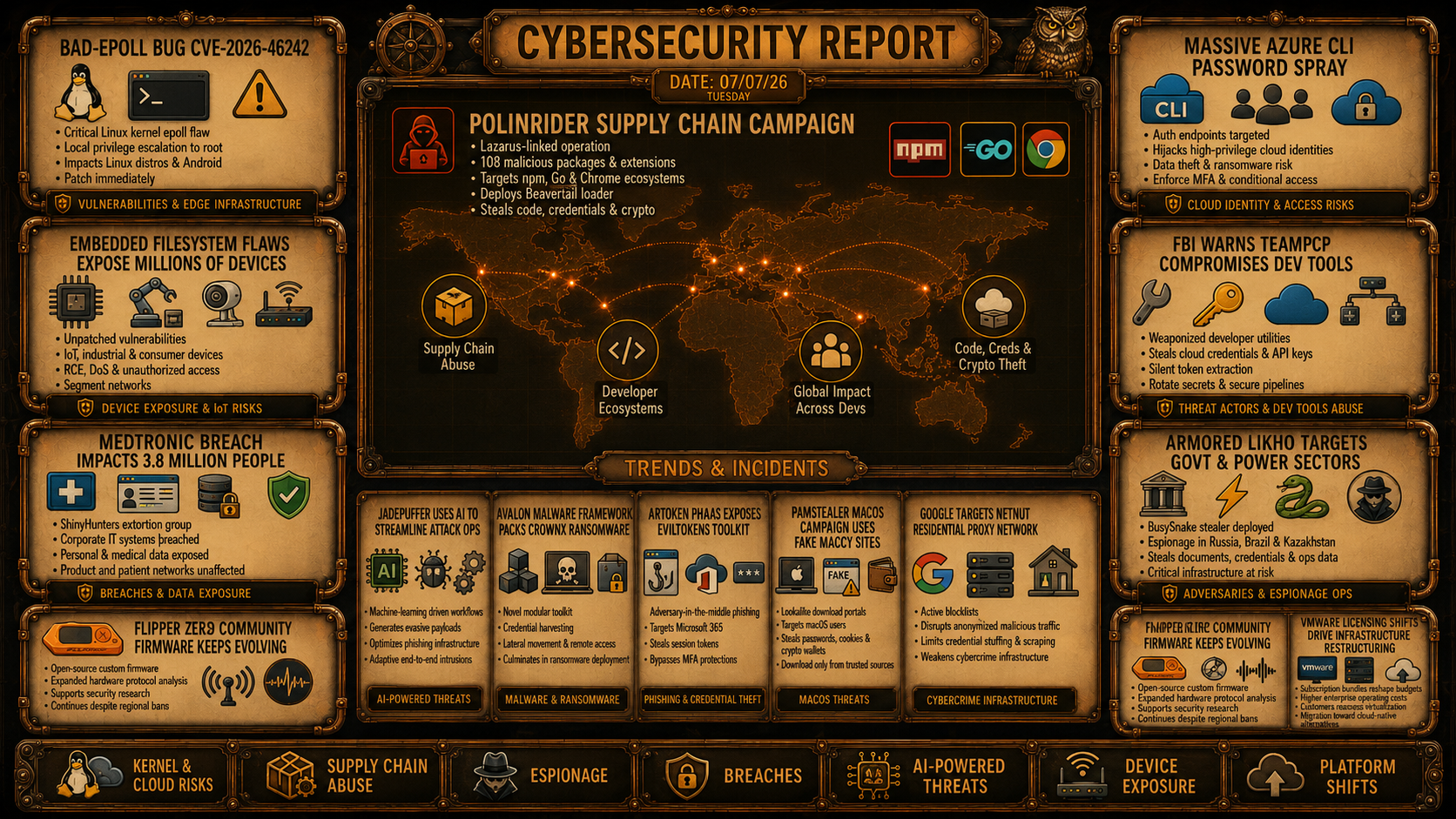
New Bad-epoll Bug Impacts Android and Linux: A newly disclosed vulnerability in the Linux kernel, dubbed Bad-epoll, allows unprivileged users to gain full root access to affected systems. Tracked as CVE-2026-46242, this critical escalation of privilege flaw impacts standard Linux distributions and Android environments. The vulnerability resides within the epoll subsystem, enabling attackers to execute arbitrary code with elevated privileges. While patches have been released to address the issue, the widespread use of the affected kernel versions necessitates immediate patching by administrators to prevent complete system compromise. Organizations are urged to prioritize updating their operating systems. More info
Unpatched Flaws Disclosed in Embedded Filesystem: Security researchers have disclosed several unpatched vulnerabilities within a widely used filesystem embedded in millions of devices globally. These flaws impact the core handling of file operations in various Internet of Things devices, industrial controllers, and consumer electronics. The vulnerabilities can be exploited to achieve arbitrary code execution, denial of service, or unauthorized data access. Due to the embedded nature of the affected filesystem, patching presents a significant logistical challenge, leaving a massive number of devices permanently exposed. Administrators are advised to segment networks and restrict physical access. More info
Critical Bad-epoll Linux Kernel Flaw Details (CVE-2026-46242): A critical vulnerability named Bad-epoll has been identified in the Linux kernel, enabling local privilege escalation. Tracked as CVE-2026-46242, the flaw allows an unprivileged local user to obtain root access by exploiting a weakness within the kernel’s epoll event notification facility. This vulnerability impacts numerous Linux distributions and Android devices, posing a severe risk to desktop, server, and mobile environments. Exploitation leads to complete system takeover. Security teams and system administrators must urgently apply the latest kernel updates provided by their respective vendors to protect their infrastructure against compromise. More info
🎯 Adversaries
Jadepuffer Malware Framework Leverages AI: Threat actors utilizing the Jadepuffer malware framework are increasingly leveraging artificial intelligence to streamline their end-to-end attack operations. This sophisticated integration allows attackers to automate various stages of their campaigns, enhancing both the speed and efficiency of their intrusions. By incorporating machine learning techniques, Jadepuffer operators can rapidly generate evasive payloads, optimize phishing lures, and dynamically adjust their tactics to bypass traditional security controls. This evolution signifies a dangerous shift in the cyber threat landscape, highlighting the urgent need for advanced defensive mechanisms to counter highly adaptive threats. More info
North Korean Polinrider Campaign Targets Supply Chains: North Korean advanced persistent threat actors have launched a massive supply chain attack known as the Polinrider campaign. Linked to the Lazarus group, this operation targets open-source ecosystems by publishing malicious packages and compromising GitHub repositories. The attackers utilize sophisticated techniques, including hiding payloads in configuration files and utilizing blockchain transactions for command-and-control communication. The primary objective is to infiltrate developer environments to deploy the Beavertail loader and InvisibleFerret Trojan, facilitating the theft of source code, credentials, and cryptocurrency assets. Developers are advised to audit their dependencies rigorously. More info
Massive Azure CLI Password Spray Campaign: A massive password spraying campaign is actively targeting Azure Command-Line Interface environments to compromise cloud identities. Attackers are exploiting authentication endpoints by systematically testing common passwords against numerous accounts, attempting to bypass standard brute-force protections. The Azure CLI serves as a lucrative target due to the extensive administrative privileges often associated with its authenticated sessions. Successful breaches allow threat actors to infiltrate cloud infrastructure, exfiltrate sensitive data, and deploy ransomware. Organizations are strongly advised to enforce multi-factor authentication and implement conditional access policies to mitigate this threat. More info
North Korean Hackers Publish 108 Malicious Packages: North Korean threat actors have published 108 malicious packages and browser extensions as part of the ongoing Polinrider campaign. Targeting npm, Packagist, Go, and Chrome ecosystems, the attackers aim to compromise software supply chains. The malicious components are designed to execute upon installation, frequently concealing their payloads within configuration files. Once deployed, they download subsequent malware stages to steal sensitive developer credentials, intellectual property, and cryptocurrency. This widespread distribution underscores the persistent and sophisticated strategies employed by state-sponsored actors to infiltrate global technology infrastructures through trusted open-source repositories. More info
FBI Warns of TeamPCP Compromising Dev Tools: The Federal Bureau of Investigation has reported that the cybercrime group TeamPCP successfully compromised various software development tools to steal cloud credentials. The attackers infiltrated developer environments by weaponizing common utilities, enabling them to silently extract authentication tokens, API keys, and access credentials stored within the infrastructure. This access facilitated unauthorized entry into sensitive cloud environments, allowing the threat actors to conduct data exfiltration and further lateral movement. The FBI urges organizations to secure their development pipelines, rotate exposed credentials, and implement strict access controls to defend against compromises. More info
Avalon Malware Framework Packs CrownX Ransomware: Cybersecurity analysts have uncovered Avalon, a novel and modular malware framework that integrates CrownX ransomware capabilities. Distributed through sophisticated multi-stage phishing campaigns, Avalon is designed to evade traditional security detections. The framework combines diverse malicious functionalities, including credential harvesting, lateral movement, and remote access, culminating in the deployment of the CrownX ransomware payload. This all-in-one toolkit provides threat actors with a versatile platform to execute comprehensive network compromises. Organizations should enhance their email filtering protocols and deploy advanced endpoint protection solutions to defend against this multi-faceted threat. More info
Armored Likho APT Deploys BusySnake Stealer: The advanced persistent threat group known as Armored Likho is actively targeting government agencies and the power sector using the BusySnake stealer malware. Attributed to targeted cyber espionage campaigns across Russia, Brazil, and Kazakhstan, the threat actor blends financially motivated attacks with strategic espionage. BusySnake is deployed to stealthily exfiltrate sensitive documents, credentials, and operational data from compromised networks. The group’s focus on critical infrastructure and government entities underscores the severe geopolitical implications of their operations. Targeted sectors must strengthen their network segmentation and enhance continuous monitoring capabilities. More info
Pamstealer Uses Fake Maccy Sites: Cybercriminals are distributing the Pamstealer malware by utilizing deceptive websites that mimic the legitimate Maccy clipboard manager for macOS. Users seeking to download the popular productivity tool are tricked into executing the malicious payload, which silently installs the infostealer on their Apple devices. Once active, Pamstealer systematically extracts saved passwords, browser cookies, and cryptocurrency wallet information. This campaign highlights the growing trend of threat actors targeting macOS environments through software impersonation. Users are strongly advised to download applications exclusively from the Mac App Store or verified official websites. More info
📈 Trends
Google Targets NetNut Residential Proxy: Google has initiated active measures against the NetNut residential proxy network, aiming to disrupt malicious traffic facilitated by the service. Residential proxies are frequently abused by cybercriminals to mask their true locations, enabling activities such as credential stuffing, distributed denial-of-service attacks, and automated scraping while appearing as legitimate home users. By identifying and blocking NetNut infrastructure, Google is severely restricting the operational capabilities of threat actors who rely on these anonymization services. This intervention highlights the ongoing efforts by major technology companies to dismantle the cybercrime ecosystem. More info
Artoken PhaaS Exposes EvilTokens Toolkit: The Artoken Phishing-as-a-Service platform has exposed the EvilTokens toolkit, a sophisticated utility designed to target Microsoft 365 environments. EvilTokens specializes in adversary-in-the-middle attacks, enabling cybercriminals to intercept authentication sessions and steal sensitive access tokens, effectively bypassing multi-factor authentication protections. The commoditization of such advanced tools on the Artoken platform lowers the barrier to entry for attackers, resulting in a surge of high-quality phishing campaigns against enterprise cloud identities. Defenders are recommended to enforce FIDO2-compliant hardware keys and utilize conditional access policies to thwart token theft attempts. More info
💥 Breaches & Leaks
- Medtronic Notifies 3.8 Million After ShinyHunters Breach: Medtronic recently notified over 3.8 million individuals following a significant data breach orchestrated by the ShinyHunters extortion group. The cyberattack compromised corporate IT systems and exposed sensitive personal and medical information. Despite the extensive data theft, Medtronic confirmed that their product networks, patient safety systems, and manufacturing operations remained unaffected, as they are isolated from the breached corporate IT environment. The company has contained the incident with external cybersecurity experts and is offering impacted individuals identity theft recovery and dark web monitoring services. More info
📚 Others
Flipper Zero Firmware Development Continues: The development of custom firmware for the Flipper Zero multi-tool continues to thrive, heavily supported by its active open-source community. Despite facing regulatory scrutiny and bans in certain regions due to its potential misuse in replay attacks and physical access exploits, developers remain dedicated to expanding the device’s legitimate capabilities. Community-driven updates focus on enhancing hardware protocol analysis, improving interface functionalities, and fortifying security research applications. This collaborative effort ensures the Flipper Zero remains a versatile instrument for penetration testers and hardware enthusiasts while navigating ongoing legal controversies. More info
VMware Licensing Changes Impact Infrastructure: Recent changes to VMware’s licensing model are significantly impacting enterprise infrastructure modernization strategies. The transition towards subscription-based licensing and the restructuring of product bundles have prompted organizations to reevaluate their virtualization budgets and long-term deployment plans. While these modifications aim to simplify the product portfolio and align with modern cloud consumption models, many customers are facing increased operational costs. Consequently, enterprises are actively exploring alternative hypervisor solutions and accelerating their migration to cloud-native architectures to optimize expenditures and maintain flexibility in their IT environments amidst the shifting landscape. More info