Cybersecurity Newsfeed - 23/06/26
Daily cybersecurity news covering vulnerabilities, adversaries, trends, breaches, and other notable security developments.
Cybersecurity Newsfeed
📅 23/06/26
🛡️ Vulnerabilities
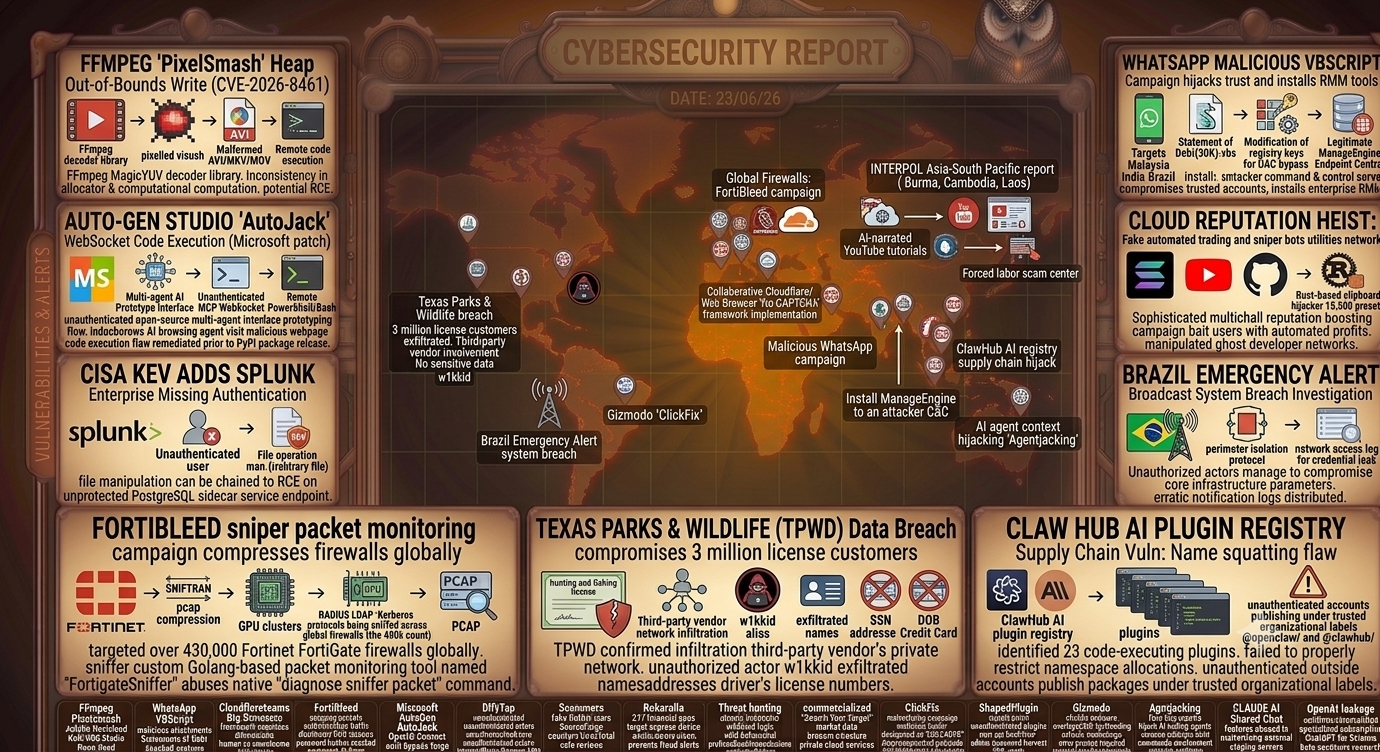
FFmpeg ‘PixelSmash’ Heap Out-of-Bounds Write (CVE-2026-8461): A high-severity flaw has been discovered in the MagicYUV decoder’s slice handling within the widely used FFmpeg video decoder library. Triggered by malicious AVI, MKV, or MOV files, it can lead to remote code execution if ASLR is bypassed. Popular media applications like Jellyfin, Nextcloud, Kodi, and OBS Studio are affected, but the flaw has been addressed in version 8.1.2. More info
Microsoft Patches “AutoJack” Chain in AutoGen Studio: Microsoft has fixed a severe vulnerability chain in the open-source AutoGen Studio interface used for prototyping multi-agent AI systems. The exploit combines local Model Context Protocol (MCP) WebSocket weaknesses, missing API route authentication, and unsafe execution of base64-encoded parameters, which could allow remote attackers to execute arbitrary commands. More info
“DifyTap” Vulnerabilities Exposed in Dify AI Platform: Security researchers detailed four flaws (CVE-2026-41947 through CVE-2026-41950) in the Dify open-source AI agentic workflow platform. The critical defects allow unauthenticated actors to traverse internal Plugin Daemon APIs, bypass cross-tenant boundary checks, and expose private LLM conversations, alongside exposing a PDFium vulnerability (CVE-2024-5846). Most flaws are addressed in version 1.14.2. More info
ClawHub AI Plugin Registry Supply Chain Flaws: A security analysis exposed structural supply chain vulnerabilities in the ClawHub AI plugin registry, which serves advanced models like Claude and OpenClaw. Researchers identified 23 code-executing plugins that successfully hijacked official administrative scopes due to a lack of namespace restrictions, allowing unauthenticated outside accounts to publish packages under trusted labels. More info
🎯 Adversaries
Malicious WhatsApp Campaign Installs Admin Tools: A malicious campaign is spreading heavily obfuscated VBScript attachments via compromised accounts to trusted contacts across Malaysia, India, and Brazil. The multi-stage infection chain bypasses Windows UAC prompts via registry modifications to silently install ManageEngine Endpoint Central, connecting the victim directly to an attacker-controlled C2 server. More info
“FortiBleed” Campaign Targets 430k Fortinet Firewalls: A massive credential-harvesting campaign has targeted over 430,000 Fortinet FortiGate firewalls globally. Attackers deploy a custom Golang-based packet monitoring tool named “FortigateSniffer” to abuse native diagnostic commands, capturing authentication traffic across 24 protocols. The collected password hashes are subsequently cracked using rented distributed GPU clusters. More info
Crypto Heist Orchestrated via Manipulated Reputation Networks: Threat actor JoseCmanXD and associated syndicates have deployed fake trust signals across GitHub repositories, SourceForge projects, and VirusTotal to distribute a multi-platform cryptocurrency clipper. The payload uses ghost developer networks to manipulate community ratings and deploys a Rust-based tool that silently swaps copied crypto wallet addresses with attacker-controlled addresses. More info 1 More info 2 New “OXLOADER” Delivers CastleStealer via Google Ads: A novel malvertising campaign uses malicious Google Ads to target users searching for popular software utilities, redirecting them to phishing pages that drop weaponized payloads. The loader establishes persistence and serves as the primary delivery mechanism for “CastleStealer,” an info-stealer focused on extracting system credentials, cookies, and crypto wallets. More info
- “AryStinger” Malware Spreads Across 4,300 Legacy Routers: A stealthy malware strain has compromised thousands of legacy home routers built on older Realtek RTL819X chips (primarily Linksys and D-Link models) as well as QNAP NAS devices. Instead of launching typical DDoS attacks, AryStinger builds a distributed reconnaissance and traffic proxy network to run parallel DNS scanning and custom script executions anonymously. More info
📈 Trends
Cloudflare and Browsers Partner to Replace CAPTCHAs: Cloudflare has teamed up with major web browser developers to implement a brand new technical framework designed to differentiate between legitimate human visitors and bots. Leveraging native browser capabilities and cryptographic telemetry, the system aims to reduce reliance on intrusive CAPTCHAs while maintaining robust security boundaries. More info
Rise of “Search Your Target” Stolen Credential Economy: A highly commercialized underground market has emerged to fill the operational gap between raw infostealer logs and account takeover intrusion actions. Threat actors process databases containing tens of billions of lines of stolen credentials into searchable private cloud services, functioning like initial access brokers by transforming raw noise into precise corporate targets. More info
INTERPOL Report Warns of Industrial-Scale Cybercrime Surge: INTERPOL’s latest Cyberthreat Assessment Report details a dramatic surge in cybercrime across the Asia and South Pacific regions. Transnational syndicates are utilizing forced labor within massive scam centers to generate $37 billion in regional losses by blending deepfakes and AI personas into social engineering scams, while info-stealers heavily weaponize corporate regulatory disclosures. More info
Shift Toward Deep Behavioral Context in Threat Hunting: Threat hunting engineering requires shifting focus beyond traditional atomic indicators of compromise toward deep behavioral context to identify stealthy detection misses. Security analysts are successfully tracking complete malware families by applying wildcard logic to static behavioral prefixes and validating rules within sandbox environments. More info
💥 Breaches & Leaks
Texas Parks and Wildlife Breach Exposes 3M Customers: The Texas Parks and Wildlife Department suffered a massive data breach compromising the personal details of approximately three million hunting and fishing license customers. Orchestrated via an infiltration of a third-party vendor’s network by an actor using the alias “w1kkid,” the breach exposed names, addresses, emails, and driver’s licenses. Highly sensitive data like SSNs and credit cards remained unaffected. More info
Brazil Investigates National Emergency Alert System Breach: Brazilian authorities have launched a formal investigation into a major security breach targeting the national emergency alert broadcast system. Unauthorized actors compromised core infrastructure parameters to distribute fraudulent public safety warnings across regional transmission cells. Cyber security response teams immediately initiated perimeter isolation protocols. More info
Gizmodo Hit with “ClickFix” Overlays Following Account Compromise: Gizmodo readers were targeted with malicious script injections on trending articles following an administrative account compromise on the media platform. When users visited affected pages, the scripts generated convincing browser error prompts claiming an update was required, executing a payload designed to harvest local system credentials and session cookies. More info