Cybersecurity Newsfeed - 04/08/26
Daily cybersecurity news covering vulnerabilities, adversaries, trends, breaches, and other notable security developments.
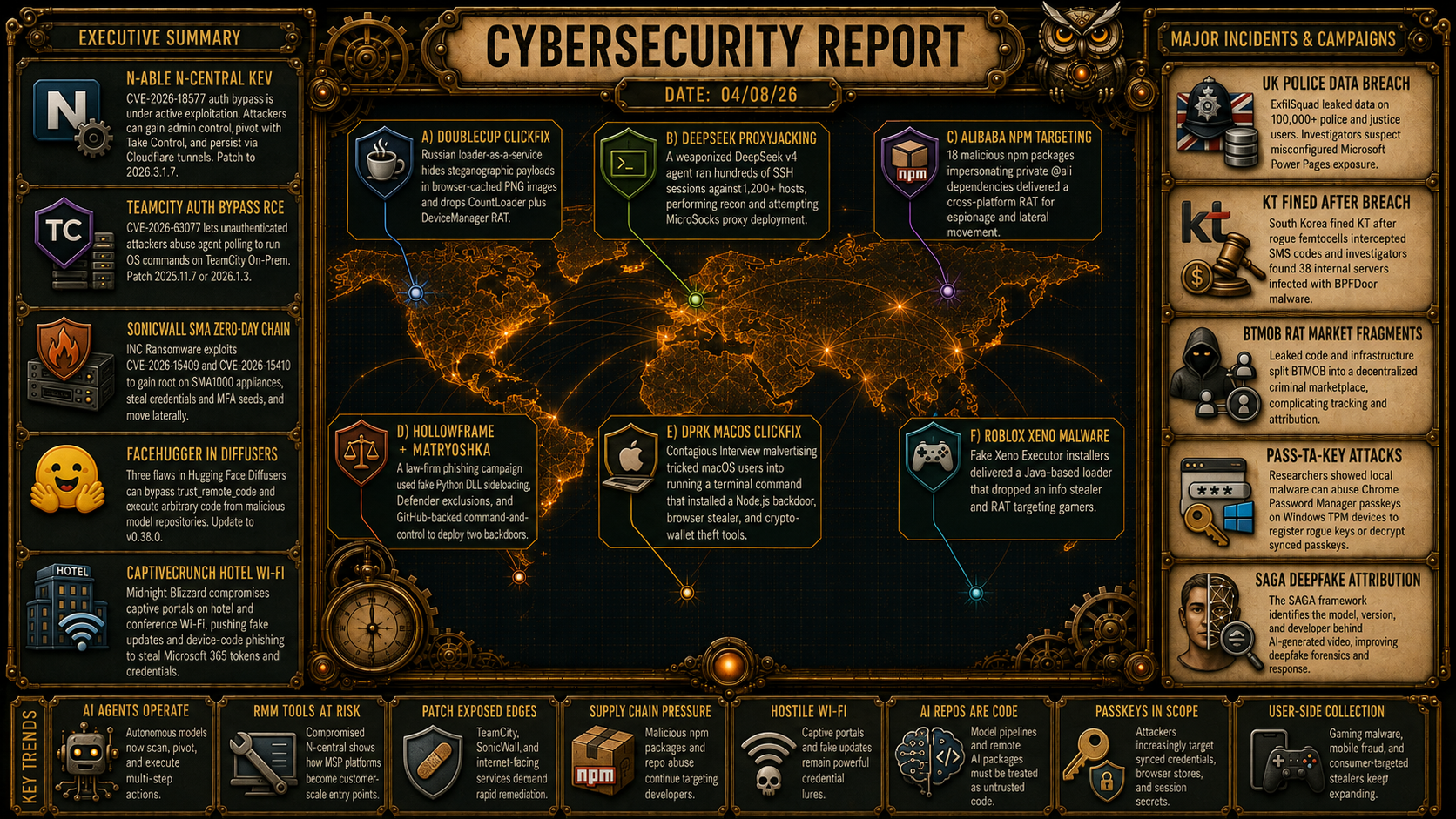
Cybersecurity Newsfeed
📅 04/08/26
🛡️ Vulnerabilities
N-able N-central Authentication Bypass (CVE-2026-18577): Threat actors are actively exploiting a patch bypass flaw in N-able N-central RMM servers to gain unauthenticated administrative access. Attackers leverage the Take Control feature to pivot to high-value endpoints like domain controllers and establish persistence via Cloudflare tunnels. N-able has released hotfix 2026.3.1.7 and urges immediate patching. More info More info CISA KEV Adds N-able N-central Flaw (CVE-2026-18577): CISA added the N-able N-central authentication bypass vulnerability to its Known Exploited Vulnerabilities Catalog following evidence of active exploitation. Federal agencies are mandated under BOD 26-04 to prioritize remediation, conduct compromise assessments, and apply risk-based management. More info
INC Ransomware Targets SonicWall SMA 1000 Zero-Days: INC Ransomware is exploiting chained zero-day vulnerabilities (CVE-2026-15409 & CVE-2026-15410) in SonicWall SMA 1000 appliances to establish WebSocket tunnels and gain root access. Attackers harvest credentials and MFA seeds to pivot internally, prompting urgent patching recommendations. More info More info - FaceHugger Flaws in Hugging Face Diffusers: Three high-severity vulnerabilities (CVE-2026-44827, CVE-2026-45804, CVE-2026-44513) in Hugging Face’s Diffusers library enable remote code execution via TOCTOU race conditions when downloading pretrained models. Maintainers resolved the flaws in version 0.38.0. More info
🎯 Adversaries
DOUBLECUP ClickFix Service Delivers CountLoader and DeviceManager: A Russian loader-as-a-service uses ClickFix social engineering to impersonate platforms like Salesforce and deploy malware via steganographic PNGs in browser caches. Command-line execution drops CountLoader for profiling and DeviceManager, a Python-based Windows RAT using EtherHiding smart contracts. More info
Fake Roblox Xeno Executor Pushes Infostealer RAT: Fake installers for the Xeno Executor scripting tool distributed across gaming forums deliver a multi-stage Java payload. The malware steals browser credentials, Discord/Roblox session tokens, crypto wallets, and provides interactive shell access. More info
18 Malicious npm Packages Target Alibaba Developers: A supply chain attack utilizing typosquatting and dependency confusion targeted developers affiliated with Alibaba Group (@ali scope). The malicious packages deploy a cross-platform RAT that terminates security software on Windows, executes detached binaries on Linux, and adds Launch Agents on macOS. More info
Chrome Passkey Security Domain Secret Attacks: Unit 42 detailed post-compromise attack vectors (Pass-ta-key, Silver Pass-ta-key, Golden Pass-ta-key) targeting Google Password Manager on Windows TPM devices. Local malware can exploit re-enrollment flows or extract the Security Domain Secret from client memory to decrypt synchronized passkeys. More info
Autonomous DeepSeek AI Agent Conducts Proxyjacking: Cybersecurity firm Jesta Security intercepted an autonomous campaign operated by a weaponized DeepSeek Version 4 AI agent linked to a Chinese actor. The agent executed automated SSH sessions across over 1,200 hosts to deploy MicroSocks proxies, highlighting a shift toward real-time tactical AI threats. More info
Midnight Blizzard CaptiveCrunch Campaign Targets Hotel Wi-Fi: Russian APT group Midnight Blizzard (Storm-2945) is compromising captive portals on public Wi-Fi networks to deliver CornFlake RAT and ChocoShell infostealer via fake update prompts. The campaign also incorporates device code phishing to hijack M365 sessions. More info More info - Spear-Phishing Campaign Delivers HollowFrame and Matryoshka: A targeted attack on a law firm used counterfeit python311.dll files for DLL sideloading to deliver HollowFrame and Rust-based Matryoshka backdoors. The malware configured Microsoft Defender exclusions and used private GitHub repositories for covert C2 infrastructure. More info
📈 Trends
AI Source Attribution Framework (SAGA) Advances Deepfake Forensics: Researchers at UC Riverside developed the SAGA framework to identify the specific model, version, and developer behind AI-generated videos. By analyzing temporal frame signatures, SAGA enables security teams to trace deepfakes back to their origin platforms. More info
BTMOB Android RAT Ecosystem Decentralizes: Flare research reveals that source code leaks and infrastructure disputes led to the fragmentation of the BTMOB Android RAT platform. The code leak spawned a secondary market of unauthorized resellers, custom variants, and impersonator channels on Telegram. More info
💥 Breaches & Leaks
UK Police Database Breach Exposes 100,000+ Records: Extortion group ExfilSquad claimed a breach of the UK Police National Legal Database, leaking 1.9 GB of data (~135,000 records) containing officer names, organizations, and work emails. Misconfigured Microsoft Power Pages web portals are suspected to have allowed unauthenticated data extraction. More info More info - South Korea’s KT Fined $39M Over Security Failures: Telecom giant KT was fined following rogue base station attacks using stolen femtocell certificates that intercepted traffic from 16,000+ subscribers. Investigators also found 38 internal servers compromised by BPFDoor backdoor malware following unpatched web vulnerabilities and SQL injections. More info