Cybersecurity Newsfeed - 02/07/26
Daily cybersecurity news covering vulnerabilities, adversaries, trends, breaches, and other notable security developments.
Cybersecurity Newsfeed
📅 02/07/26
🛡️ Vulnerabilities
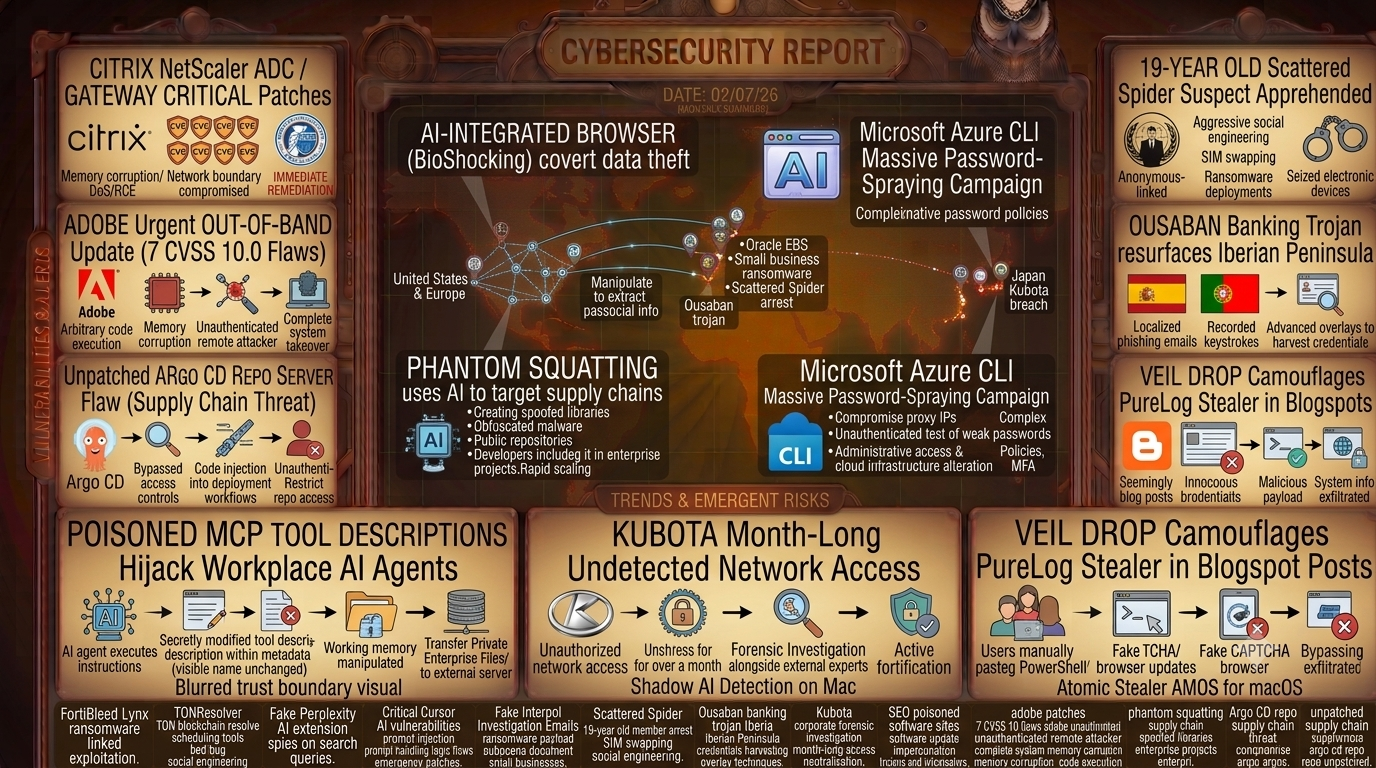
Unpatched Argo CD Repo Server Flaw: A critical, currently unpatched vulnerability has been identified in the Argo CD repository server component posing a severe risk to continuous delivery pipelines. The flaw could allow unauthenticated attackers to bypass access controls and potentially inject malicious code into deployment workflows compromising the integrity of downstream applications. More info
Adobe Patches 7 CVSS 10.0 Flaws: Adobe has released an urgent out-of-band security update addressing seven critical vulnerabilities, all carrying a maximum CVSS score of ten, across its product suite. These severe flaws primarily involve arbitrary code execution and memory corruption vulnerabilities that could be exploited by unauthenticated remote attackers to seize complete control of affected systems without any user interaction. More info
Critical Cursor AI Prompt Injection Flaws: Security researchers have disclosed critical vulnerabilities in the Cursor AI code editor that could allow attackers to execute arbitrary code via prompt injection attacks. By crafting malicious input prompts, threat actors can bypass the application sandboxing mechanisms potentially leading to local file access, data exfiltration, or the execution of unauthorized commands on the developer workstation. More info
Apple Hide My Email Privacy Exploit: A significant privacy vulnerability has been uncovered within Apple Hide My Email service inadvertently allowing unauthorized parties to resolve anonymous relay addresses back to the user actual private email accounts. The flaw undermines the core functionality of the privacy feature potentially exposing millions of users to targeted spam, phishing, and doxxing campaigns. More info
Citrix NetScaler Gateway Mitigation: Citrix has released critical security advisories detailing patches for six distinct vulnerabilities affecting its NetScaler ADC and Gateway appliances, which CISA has flagged for immediate remediation. The identified flaws encompass memory corruption, improper privilege management, and cross-site scripting vulnerabilities that enable denial-of-service conditions and remote code execution at the network boundary. More info
🎯 Adversaries
FortiBleed Campaign Linked to Lynx Ransomware: A credential theft campaign dubbed FortiBleed has been discovered demonstrating strong operational links to the Lynx ransomware syndicate. Threat actors are exploiting known vulnerabilities in Fortinet appliances to harvest sensitive login credentials from compromised networks. This stolen data is subsequently utilized to facilitate initial access and lateral movement for deploying the Lynx ransomware payload. More info
ChocoPoC Malware Targets Security Analysts: Cybersecurity researchers are being targeted by a novel malware strain named ChocoPoC which is distributed through trojanized Proof-of-Concept exploits on code-sharing platforms. Attackers disguise the malicious payloads as legitimate vulnerability testing tools to lure security professionals into executing them within their environments. Once activated, ChocoPoC establishes a backdoor allowing threat actors to steal proprietary research, sensitive vulnerability data, and internal network credentials. More info
Fake Perplexity Extension Conducting Surveillance: A malicious Google Chrome extension masquerading as the popular AI search tool Perplexity has been discovered actively spying on user search queries and browsing activities. Distributed through deceptive online advertisements, the rogue extension intercepts search data and exfiltrates it to remote command-and-control servers for potential monetization or targeted exploitation. More info
Fake Google Notes Extension Swapping Crypto Wallets: A newly identified fraudulent browser extension deceptively branded as Google Notes is being utilized by threat actors to stealthily manipulate cryptocurrency transactions. Once installed, the malicious extension monitors web traffic for cryptocurrency addresses employing a clipboard-hijacking technique to automatically swap the intended recipient wallet address with one controlled by the attackers. More info
Ousaban Banking Trojan Resurfaces: The notorious Ousaban banking trojan has resurfaced in a highly targeted campaign aimed at financial institutions and their customers across the Iberian Peninsula. The malware is primarily distributed via localized deceptive phishing emails containing malicious attachments that initiate the infection chain. Once executed, Ousaban establishes persistence, records keystrokes, and utilizes advanced overlay techniques to harvest sensitive banking credentials during active sessions. More info
Ransomware Campaigns Pose as Interpol Investigations: Small businesses are currently facing a surge in targeted ransomware attacks facilitated by highly convincing phishing emails masquerading as official Interpol investigation notices. The fraudulent communications allege that the recipient business is implicated in international financial crimes pressuring them into downloading an attached subpoena document. This malicious attachment executes a ransomware payload that rapidly encrypts critical business data. More info
Veil Drop Espionage Distributes PureLog Stealer: A sophisticated cyber espionage campaign known as Veil Drop has been observed utilizing the Blogspot platform to stealthily distribute the PureLog infostealer malware. Attackers are embedding malicious payloads within seemingly innocuous blog posts leveraging the platform trusted domain reputation to evade traditional web filters and security scanners. More info
Modular RustDuck Botnet Expanding: Analysts have identified RustDuck, a newly emerging botnet written entirely in the Rust programming language indicating a highly sophisticated development lifecycle. Although currently maintaining a small footprint, its modular architecture and advanced evasion techniques suggest the operators are laying the groundwork for a massive scalable cybercriminal enterprise targeting vulnerable IoT devices and Linux servers. More info
Massive Password-Spraying Targets Azure CLI: Security telemetry has detected a massive globally distributed password-spraying campaign specifically targeting Microsoft Azure Command-Line Interface endpoints. Threat actors are utilizing vast networks of compromised proxy IPs to systematically test weak or commonly used passwords against administrative accounts attempting to bypass standard authentication safeguards. More info
📈 Trends
Phishing Infrastructures Deploy OS Auto-Adaptation: Recent intelligence reveals that sophisticated phishing campaigns are increasingly employing automated adaptation techniques to tailor attacks based on the victim device operating system. By analyzing the user-agent string upon initial link execution, the malicious infrastructure dynamically serves customized landing pages designed to mimic specific login portals, such as Apple iCloud for iOS or Google for Android. More info
SEO Poisoning Campaign Exploits Search Ranks: Cybercriminals are increasingly leveraging Search Engine Optimization poisoning to manipulate search results and direct users to malicious software download sites. These fraudulent websites impersonate legitimate vendors to distribute malware payloads cleverly disguised as popular software updates or productivity tools, bypassing traditional security filters. More info
AI-Driven Phantom Squatting Attacks: A novel supply chain attack vector termed Phantom Squatting is leveraging artificial intelligence to generate highly convincing malicious software packages. Threat actors use AI models to automatically create libraries that spoof legitimate dependencies embedding sophisticated obfuscated malware within them, challenging standard automated security scanners. More info
BioShocking Method Manipulates AI Browsers: Researchers have conceptualized a novel attack vector termed BioShocking which targets the emerging class of AI-integrated web browsers to facilitate covert data theft. By injecting adversarial prompts into rendered web pages, attackers can manipulate the browser underlying language model into extracting sensitive user data, such as auto-filled passwords or financial information. More info
Microsoft Safeguards Roadmap Against Quantum Threats: In response to the escalating threat posed by rapid advancements in quantum computing capabilities, Microsoft has announced a significant acceleration of its quantum-safe cryptography roadmap. The initiative aims to expedite the integration of post-quantum cryptographic algorithms across its entire ecosystem, including Windows, Azure, and Microsoft 365. More info
💥 Breaches & Leaks
- Kubota Corporation Suffers Month-Long Network Intrusion: Kubota Corporation disclosed a significant cybersecurity breach where malicious actors maintained unauthorized access to its internal network systems for over a month. The prolonged intrusion potentially exposed sensitive corporate and operational data before security teams detected and neutralized the threat. Following the discovery, Kubota initiated a comprehensive forensic investigation alongside external cybersecurity experts. More info
📚 Others
- Key Scattered Spider Syndicate Suspect Arrested: International law enforcement agencies have apprehended a nineteen year old suspect believed to be a key member of the notorious Scattered Spider cybercriminal syndicate. The arrest marks a significant breakthrough against the group which is infamous for its aggressive social engineering tactics, SIM swapping, and ransomware deployments targeting major corporations. More info