Cybersecurity Newsfeed - 31/03/26
Daily cybersecurity news covering vulnerabilities, adversaries, trends, breaches, and other notable security developments.
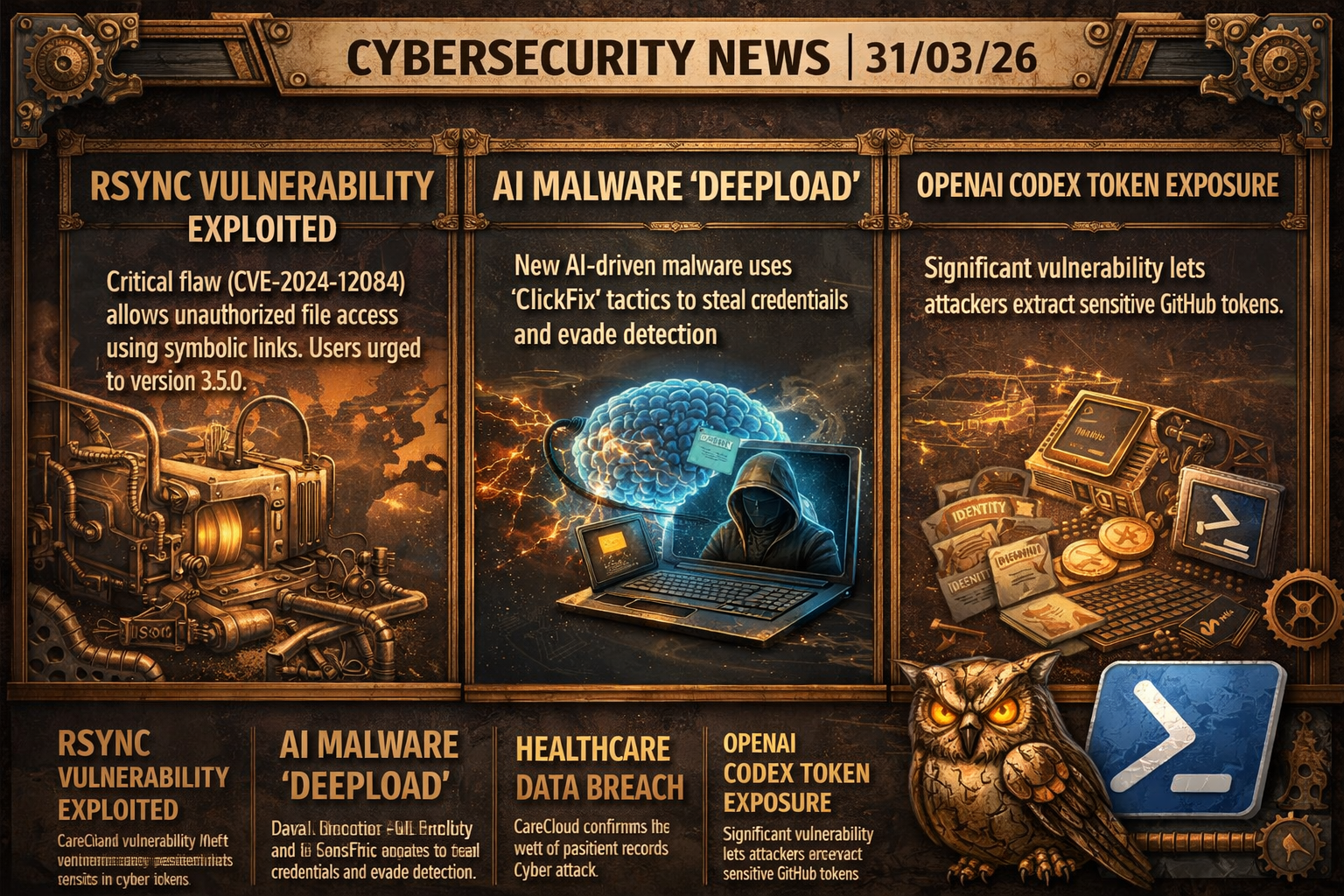
Cybersecurity Newsfeed
📅 31/03/26
🛡️ Vulnerabilities
rsync Symbolic Link Bypass (CVE-2024-12084): A critical flaw in rsync’s handling of symbolic links when
--inc-recursiveis enabled allows attackers to bypass directory restrictions. Users are urged to patch to version 3.3.0 or use--safe-linksas a mitigation. More infoOpenAI Codex Token Leakage: Researchers discovered that prompt injection and indirect training data leakage can force OpenAI Codex to reveal sensitive GitHub personal access tokens, exposing private repositories to unauthorized access. More info
Fortinet & F5 BIG-IP Reclassified as RCE: Previously known vulnerabilities in these appliances have been reclassified as critical remote code execution (RCE) flaws. Attackers can achieve full system compromise via the administrative interface without authentication. More info
CISA Adds New Flaw to KEV Catalog: CISA has added a new vulnerability to its Known Exploited Vulnerabilities Catalog, signaling active exploitation. Organizations are mandated to remediate the flaw within a defined timeframe to mitigate risk. More info
Telegram “No-Click” Remote Code Execution: A critical “no-click” vulnerability in Telegram allows for RCE on target devices simply by receiving a specially crafted media message. The flaw stems from an issue in how the app processes certain data formats. More info
strongSwan VPN DoS (Integer Underflow): An integer underflow vulnerability in strongSwan can be exploited to crash the VPN service during the processing of IKEv2 packets. Administrators should update to version 5.9.14 or later. More info
Citrix NetScaler Memory Corruption: A critical memory corruption flaw in NetScaler ADC and Gateway is being actively exploited for unauthorized data theft and session hijacking. Citrix has released emergency updates to address the buffer overflow. More info
FortiClient EMS Exploitation (CVE-2026-21643): A critical flaw in Fortinet’s FortiClient EMS allows unauthenticated attackers to execute arbitrary code with elevated privileges. Immediate patching is recommended as it is being exploited in the wild. More info
🎯 Adversaries
ROADK1LL WebSocket Implant: Security researchers identified a new implant called ROADK1LL that utilizes WebSockets to facilitate persistence and lateral movement by masquerading as legitimate web traffic. More info
China-Linked APTs Target SE Asia: Chinese threat groups launched a concentrated malware campaign against Southeast Asian government entities for long-term espionage, utilizing custom backdoors and edge device exploitation. More info
Russian CTRL Toolkit Phishing: Russian-linked threat actors are distributing the “CTRL Toolkit,” a modular set of post-exploitation tools for credential harvesting and network mapping, through targeted phishing. More info
- Infinity Stealer Targets macOS: A new malware dubbed Infinity Stealer is targeting macOS users with a Nuitka-packaged Python payload and “ClickFix” lures to steal browser data and crypto wallets. More info
📈 Trends
Wave Browser & PUP Concerns: Researchers identified privacy risks regarding Wave Browser and Ocean Cleanup Tab, classified as Potentially Unwanted Programs (PUPs) due to extensive data collection and system setting alterations. More info
Security in the “Machine Economy”: The rise of autonomous agents handling crypto payments introduces new challenges, requiring robust authentication and secure execution environments to prevent systemic financial losses. More info
AI-Enhanced Malware Evolution: The use of AI in malware development, such as in DeepLoad, allows for rapid iteration of code obfuscation, creating more adaptive threats that challenge traditional security paradigms. More info
💥 Breaches & Leaks
CareCloud Data Breach: Healthcare provider CareCloud confirmed a data breach involving unauthorized access to patient names, contact details, and medical records. Forensic investigations and law enforcement notifications are underway. More info
Alleged Lockheed Martin Data Leak: A threat actor claims to be selling 375TB of data belonging to defense contractor Lockheed Martin on a dark web marketplace, including sensitive information on military and aerospace technology. More info